Mouth breathing exercises: 7 drills to restore nasal breathing
Mouth breathing exercises train the three systems that keep your mouth closed at night: lip seal, tongue posture, and nasal airflow. Do not simply tape your mouth shut. First rule out nasal obstruction, then build the habits and muscle patterns that make nasal breathing your default.



Quick answer
Mouth breathing exercises train your lips, tongue, and nasal breathing rhythm so your default breathing path shifts from the mouth to the nose. They work best when you first rule out nasal obstruction (deviated septum, polyps, chronic congestion, large tonsils or adenoids), then practice daily for several weeks.
The evidence comes from oropharyngeal and myofunctional therapy trials that tested combined tongue, palate, and facial exercise programs. These studies (Ieto 2015, Guimaraes 2009, Camacho 2015) found meaningful reductions in snoring and, in selected populations, sleep apnea severity. Mouth tape and chin straps are temporary mechanical fixes; exercises address the underlying muscle patterns and habits.
Why people mouth-breathe at night
Mouth breathing during sleep usually has one of two root causes, and they often overlap. The first is nasal obstruction: a deviated septum, enlarged turbinates, nasal polyps, chronic allergies, or large tonsils and adenoids physically block airflow through the nose. When the nose is blocked, the mouth opens as a survival reflex.
The second is habit and muscle weakness. Your tongue sits low in the mouth instead of against the roof. Your lip seal is weak, so the mouth falls open when muscle tone drops during sleep. Even when the nose is clear enough, air follows the path of least resistance: the open mouth. The Cleveland Clinic notes that mouth breathing in children can change facial shape, affect behavior, and impair growth when the underlying airway problem goes untreated.
The right order matters. You cannot train your way past a septum that is blocking 80 percent of your nasal airway. But once structural obstruction is ruled out or managed, exercises can restore nasal breathing as the default. For additional context on temporary mouth-closing devices, see our mouth taping evidence review and chin strap analysis.
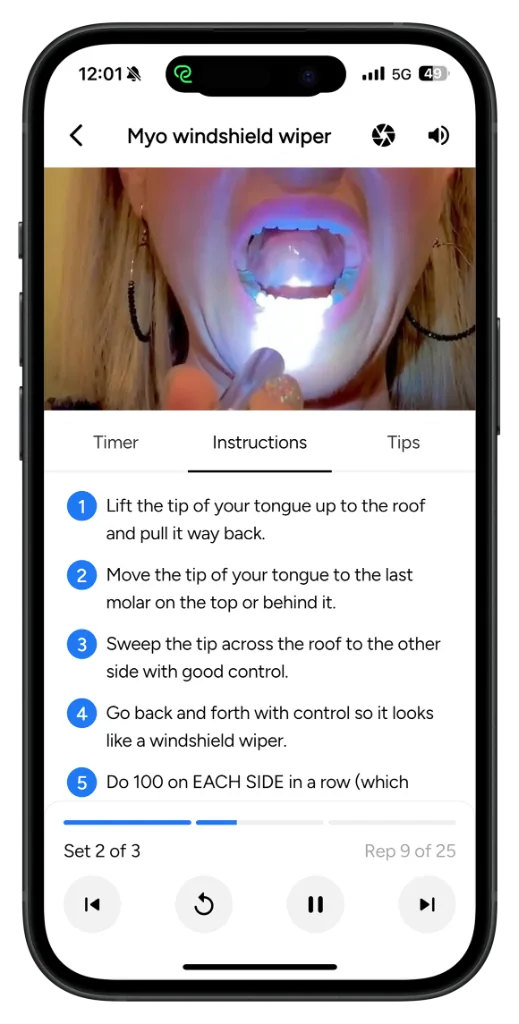
Airway Trainer structures tongue posture, lip seal, and nasal breathing drills into short guided sessions so the habit work happens daily without a handout.
When mouth breathing exercises may help
Exercises are not for everyone with an open mouth at night. Use this framework to decide whether training belongs in your plan.
Likely to respond
- Habitual daytime mouth breathing with a clear nose on the two-minute test
- Waking with dry mouth or drool but no gasping, choking, or witnessed pauses
- Snoring that is lighter, positional, or partner-reported without apnea warnings
- You can nasal-breathe at rest but the mouth falls open overnight
Limited or unlikely to respond
- Severe nasal blockage from a deviated septum, large polyps, or chronically inflamed turbinates
- Large tonsils or adenoids that physically occupy airway space (especially in children)
- Moderate-to-severe untreated obstructive sleep apnea
- Mouth breathing driven by alcohol, sedatives, or significant weight-related airway narrowing
Escalate care if...
- Gasping, choking, or witnessed pauses in breathing at night
- Daytime sleepiness, morning headaches, or resistant high blood pressure
- No improvement after 6-8 weeks of honest daily practice
- A child shows mouth breathing with facial changes, bedwetting, or behavioral concerns
7 mouth breathing exercises
These seven drills map to the three systems that keep the mouth closed at night: lip seal, tongue posture, and nasal breathing quality. If the nose itself is your bottleneck, the dedicated nasal breathing exercises routine goes further on nose-only retraining. Start with exercises 1 and 2 as your core. Add the others as your daily practice builds. Pair with throat exercises and tongue exercises for snoring if you want the full airway-training picture.
Exercise 1
Lip seal hold (button pull)
Orbicularis oris and lip seal strength
- Press your lips together gently, not forcefully. Keep your face relaxed, no chin dimpling.
- Option: tie a clean button to a string, place it between your lips (not teeth), and pull lightly outward for 5-10 seconds while keeping the button in place.
- Release, rest, and repeat. Progress by holding longer or placing the button flat between the lips for added difficulty.
Form cue: A weak lip seal is why the mouth falls open at night even when the nose is clear. Train the seal separately from tongue posture so both systems work together.
Exercise 2
Tongue-to-palate suction (full roof press)
Resting tongue posture and mouth-to-nose airway redirection
- Press the entire tongue flat against the roof of your mouth, from the tip behind the front teeth to the back.
- Create light suction so the tongue stays sealed without muscular effort.
- Hold 5-10 seconds while breathing only through your nose. Release, rest, and repeat. Progress by holding while opening your mouth slowly.
Form cue: The tongue on the roof of the mouth is the single most important mechanical shift for switching from mouth to nasal breathing. It seals the oral airway and helps suspend the soft palate.
Exercise 3
Alternate nostril breathing (nadi shodhana)
Nasal airflow awareness, respiratory rhythm, and controlled nasal breathing
- Sit tall, mouth closed, face relaxed. Close your right nostril with your right thumb.
- Inhale slowly through the left nostril for 4-5 seconds.
- Pinch both nostrils closed with thumb and index finger, hold for 2-3 seconds.
- Open the right nostril and exhale fully over 5-6 seconds.
- Inhale through the right nostril, pinch and hold, then exhale through the left. That is one full cycle.
Form cue: If one nostril feels blocked, do not force it. Shorten the inhale on the tight side and build tolerance over days. The goal is practice, not perfection.
Exercise 4
Cheek puff quadrants (air swish)
Buccinator, lip seal, and intraoral pressure awareness
- Close your lips firmly. Puff air into your right cheek and hold for 3-4 seconds.
- Push the air from the right cheek to the upper lip area, then to the left cheek, then to the lower lip area.
- Go through all four quadrants in a slow, controlled circuit. No air should escape through the nose or mouth.
- If air leaks, dial back the volume and focus on seal quality. Fill only enough to feel the stretch.
Form cue: This tool teaches your lips and cheeks to maintain an oral seal under pressure. Think of it as seal endurance, not volume.
Exercise 5
CO2 tolerance walking breath-hold
Nasal passage dilation and carbon dioxide tolerance for easier nasal breathing
- While walking at a comfortable pace, breathe only through your nose for 30-60 seconds.
- At the end of a normal exhale, pinch your nose closed and count your steps while holding your breath.
- Note how many steps you take before the first definite urge to breathe (not a max hold).
- Rest with normal nasal breathing for 1-2 minutes and repeat once or twice. The goal is not a high count; it is noticing whether the number trends up gently over weeks.
Form cue: Walk, do not run. The first urge is the signal, not gasping. This trains tolerance to the slight CO2 rise that naturally dilates nasal passages and makes nose breathing feel easier.
Exercise 6
Pointy tongue narrow-and-hold
Intrinsic tongue narrowing and side-to-side control
- Stick your tongue out straight and make it as narrow and pointy as you can by contracting the sides inward.
- Hold the narrow shape for 3-5 seconds while keeping the tip centered.
- Release, rest, and repeat. Once narrow is easy, practice moving the narrow tip left and right without letting it widen.
Form cue: A wide, flat tongue seeps into the teeth and past the lips. Narrowing trains the intrinsic muscles that keep the tongue contained inside the dental arch, supporting a closed-mouth rest posture.
Exercise 7
Closed-mouth chewing with hum
Jaw rhythm, lip seal, and nasal breathing coordination
- Close your mouth and make a soft chewing motion as if gum is between your molars.
- Add a low, closed-mouth hum ("mmm") on every chew. Keep your face relaxed and your nasal breathing steady.
- Do 30-60 seconds at a time, rest, and repeat. Increase duration as lip seal and nasal airflow improve.
Form cue: This connects three systems that mouth breathers tend to unlink: jaw rhythm, lip seal, and nasal airflow. If you cannot hum and nasal-breathe at the same time, shorten the interval.
Why mouth tape is not the starting point
Mouth tape is a passive barrier. It does not train your tongue to sit on the roof of your mouth, your lips to seal on their own, or your nose to become the default breathing path. When the tape comes off, the old patterns return because nothing underneath has changed.
More importantly, taping your mouth closed while your nose is partially blocked creates risk. A 2025 systematic review called the evidence for mouth taping marginal and flagged safety concerns when nasal obstruction is present. If your nose cannot handle the full nighttime airflow load, mouth tape turns the mouth from a backup airway into a sealed exit that is not there when you need it.
The right sequence is: rule out nasal obstruction, train nasal breathing during the day, build lip seal and tongue posture, and only then consider mouth tape as a temporary overnight cue while the trained patterns consolidate. For the full evidence breakdown, read does mouth taping work for snoring.
A 5-minute daily routine
Do not try all seven drills on day one. Use a short core that you can complete, then expand the menu over weeks.
- Tongue-to-palate suction (60 seconds): Full tongue against the roof of the mouth, light suction, five holds of about 10 seconds each while breathing through your nose.
- Lip seal hold (60 seconds): Five rounds of gentle lip press with relaxed face, 10 seconds each. Add the button pull once the base seal is steady.
- Alternate nostril breathing (90 seconds): Three slow cycles (left in, hold, right out, right in, hold, left out). Focus on smooth, quiet airflow.
- Cheek puff quadrants (45 seconds): Two full circuits through all four quadrants. Prioritize seal quality over air volume.
- Closed-mouth chewing with hum (45 seconds): One round of steady chewing and humming while nasal breathing.
That is roughly five minutes. On alternate days, swap in the pointy tongue exercise and a CO2 tolerance walking round to keep the practice varied. If you want a guided sequence with timers and progression, Airway Trainer handles the daily structure so you focus on the reps, not the stopwatch.
Nasal obstruction and sleep-apnea warning signs
Exercises cannot fix a structural blockage. Before committing weeks to a mouth breathing exercise routine, rule out these conditions:
- Deviated septum: the wall between your nostrils leans significantly to one side, blocking airflow.
- Nasal polyps: soft growths inside the nasal passages that obstruct breathing.
- Chronically enlarged turbinates: structures inside the nose that swell from allergies, infections, or irritation.
- Large tonsils or adenoids: especially in children, these physically occupy airway space and can make nasal breathing nearly impossible.
- Persistent nasal congestion that does not respond to saline rinses or over-the-counter management.
A deviated septum can be one of those structural blockers. Read our guide to deviated septum and snoring before treating exercises as the whole answer.
Sleep apnea warning signs that warrant a clinical evaluation:
- Gasping, choking, or witnessed pauses in breathing during sleep.
- Severe daytime sleepiness, morning headaches, or resistant high blood pressure.
- A partner who is alarmed by your breathing pattern at night.
- For children: mouth breathing with facial changes, bedwetting, behavioral concerns, or poor growth.
This page is educational and not medical advice. Talk to a clinician about any symptom that concerns you. Exercises support care; they do not replace evaluation or prescribed treatment.
What the evidence supports
There are no large trials testing "mouth breathing exercises" as a standalone category. The evidence comes from oropharyngeal and myofunctional therapy programs that train the same tongue, lip, and nasal breathing systems these drills target:
- Ieto et al., 2015 (RCT): oropharyngeal exercises including tongue, palate, and facial muscle work reduced snoring frequency and snoring power in habitual snorers.
- Guimaraes et al., 2009 (RCT): upper-airway exercises that included tongue and facial components improved OSA outcomes and snoring versus a sham control.
- Camacho et al., 2015 (meta-analysis): myofunctional therapy was associated with reductions in snoring and apnea-hypopnea index across pooled trials (often summarized near ~50% AHI change; individual studies vary).
For a broader study-by-study walkthrough, see oropharyngeal exercises clinical studies. For the muscle-training science, see how mouth exercises reshape the airway.
Video walkthroughs
Use these for movement context and clinician reasoning. Videos are not clinical citations. Credits: Zac Cupples (PT, DPT), Adam Fields (DC), and Sarah Hornsby (myofunctional therapist).
Zac Cupples, PT, DPT - tongue posture, lip seal, and nasal breath quality for restoring nasal breathing
Adam Fields, DC - follow-along mouth breathing routine covering face, nose, tongue, and breathing exercises
Sarah K Hornsby, MyoMentor - five-step framework for identifying and correcting chronic mouth breathing
FAQ
Do mouth breathing exercises actually work?
They can, when habitual tongue posture, weak lip seal, and poor nasal breathing coordination are the main drivers. Randomized trials of oropharyngeal programs that include tongue and facial exercises (Ieto 2015, Guimaraes 2009) reduced snoring metrics, and a myofunctional therapy meta-analysis (Camacho 2015) found pooled reductions in snoring and apnea-hypopnea index. Results take weeks of daily practice and do not replace evaluation for structural nasal obstruction or sleep apnea.
Why do I mouth-breathe at night even though I can breathe through my nose during the day?
During sleep, muscle tone drops throughout the body, including the tongue, soft palate, and lip seal. If your resting tongue posture sits low in the mouth or your lips do not naturally stay closed without conscious effort, the mouth falls open when you lose voluntary control. Nasal congestion that feels manageable during the day can become a bigger obstacle in the horizontal position. The result is mouth breathing by default, not by choice.
Is mouth tape a good starting point?
No. Mouth tape is a passive barrier, not a training tool. If you tape your mouth closed while your nose is partially blocked, you risk poor sleep or, in a worst case, asphyxiation. A 2025 systematic review called the evidence for mouth taping marginal and flagged safety concerns when the nose is obstructed. First rule out nasal obstruction, then train nasal breathing, tongue posture, and lip seal. Mouth tape may have a role later as a temporary cue, not a first step.
How are mouth breathing exercises different from throat or tongue exercises for snoring?
Throat and tongue exercises for snoring focus on stiffening the back airway tissues that vibrate or collapse during sleep. Mouth breathing exercises focus upstream: restoring nasal breathing as the default, training lip seal, and repositioning the tongue on the roof of the mouth so air takes the nose path. They overlap (tongue-to-palate work helps both goals), but the priority order is different: clear the nose, train nasal breathing, then strengthen the airway.
How long until I stop mouth breathing at night?
Habit change takes weeks, not days. Most published oropharyngeal exercise programs run about 6 to 12 weeks with daily practice. Some people notice less dry mouth within two weeks; fuller overnight nasal breathing often takes 4-8 weeks of consistent training. The lip seal and tongue posture components tend to respond faster than the nasal breathing habit itself, which often needs several weeks to feel automatic.
What if my nose is always stuffy?
Rule out structural causes first: see a clinician about a deviated septum, nasal polyps, chronically enlarged turbinates, or allergies. If your nose is clear during the day but blocks at night, try a saline rinse before bed, elevate your head slightly, and practice the CO2 tolerance exercise during the day to help nasal passages dilate more easily. If one nostril is always tighter than the other, that is normal nasal cycle physiology, not a blockage.
Can children do these exercises?
Most of these exercises can be adapted for children over age 6 with supervision. The lip seal hold, tongue-to-palate suction, pointy tongue, and closed-mouth chewing with hum are the most child-friendly. Avoid the button pull with young children due to choking risk and skip CO2 breath-holds entirely. For a child with chronic mouth breathing, see a pediatric ENT or dentist trained in airway evaluation; exercises alone are rarely enough when structural issues are present.
When should I see a doctor instead of only doing exercises?
See a clinician if you gasp or choke at night, have witnessed breathing pauses, severe daytime sleepiness, morning headaches, or resistant high blood pressure. See an ENT if your nose is persistently blocked despite saline rinses and allergy management. For children, see a provider if mouth breathing is accompanied by facial changes, bedwetting, behavioral issues, or poor growth. Exercises can support care; they should not delay diagnosis or prescribed treatment.
Sources
- Cleveland Clinic. Mouth Breathing. Last reviewed July 2025. - Authoritative overview of mouth breathing causes, symptoms, complications, and treatment from a major academic medical center. Source
- Ieto V, et al. Chest. 2015 Sep;148(3):683-691. PMID: 25950418. - Randomized trial: oropharyngeal exercises reduced snoring frequency and snoring power in habitual snorers (multi-structure program including tongue, palate, and facial exercises). Source
- Guimaraes KC, et al. Am J Respir Crit Care Med. 2009 May 15;179(10):962-968. PMID: 19234106. - Randomized trial: upper-airway (oropharyngeal) exercises improved obstructive sleep apnea outcomes and snoring versus sham control. Source
- Camacho M, et al. Sleep. 2015 May 1;38(5):669-675. PMID: 25348130. - Meta-analysis of myofunctional therapy for OSA: pooled trials show meaningful reductions in snoring and apnea-hypopnea index (often summarized near ~50% AHI change across analyses; individual studies vary). Source
- Goswami U, et al. Sleep Breath. 2019 Mar;23(1):243-250. PMID: 30032464. - Smartphone-guided oropharyngeal exercise delivery for snoring. Source
- Zac Cupples, PT, DPT. 3 Keys to STOP Mouth Breathing FOREVER. - Demonstration context only: physical therapist walkthrough of tongue posture, lip seal, and nasal breath quality for restoring nasal breathing; not a clinical citation. Source
- Adam Fields, DC. V3 of 3 Mouth Breather, Snoring and Sleep Apnea Exercises. - Demonstration context only: follow-along mouth breathing and snoring routine covering face, nose, tongue, and breathing exercises. Source
- Sarah K Hornsby, MyoMentor. How to Stop Mouth Breathing In Five Easy Steps. - Demonstration context only: myofunctional therapist five-step framework for identifying and correcting chronic mouth breathing. Source
Train the habit, not just the barrier
Airway Trainer gives you short daily sessions for tongue posture, lip seal, and nasal breathing drills with timers and progression. The goal is not to remember a handout. It is to rebuild the patterns that make nasal breathing automatic.
Related: mouth breathing statistics · does mouth taping work · airway retraining · throat exercises · tongue exercises · mewing and snoring