Tongue exercises for snoring: 9 free drills that target collapse
Tongue exercises for snoring train the muscle that most often falls backward and narrows the airway in sleep. This guide covers 9 practical drills, hospital and ENT demonstration context, trial-backed expectations, and a simple daily structure you can finish.



Quick answer
Tongue exercises for snoring strengthen and coordinate the tongue so it is less likely to fall back and crowd the airway. They work best as part of a full oropharyngeal routine (tongue + soft palate + throat), practiced daily for weeks - not as a one-night trick.
The best evidence is for combined upper-airway exercise programs, not for a single viral tongue move. Randomized trials and a myofunctional therapy meta-analysis support reductions in snoring intensity and, in selected populations, apnea severity. If you have signs of sleep apnea, get evaluated; exercises support care, they do not replace it.
Why the tongue is a major snoring lever
During sleep, muscle tone drops. The tongue is a large, mobile structure sitting just in front of the airway. When its base falls backward - especially on your back - it narrows the space behind the tongue (the retrolingual airway). Air then becomes turbulent and noisy, and in some people the airway can partially or fully obstruct.
That is why hospital sleep units and ENT-facing programs put so much weight on tongue posture and tongue strength: higher tone and a palate-resting tongue position can reduce collapsibility. Tongue work is not the whole story (soft palate, sidewalls, nose, weight, alcohol, and anatomy all matter), but it is one of the highest-leverage voluntary muscles you can train at home.
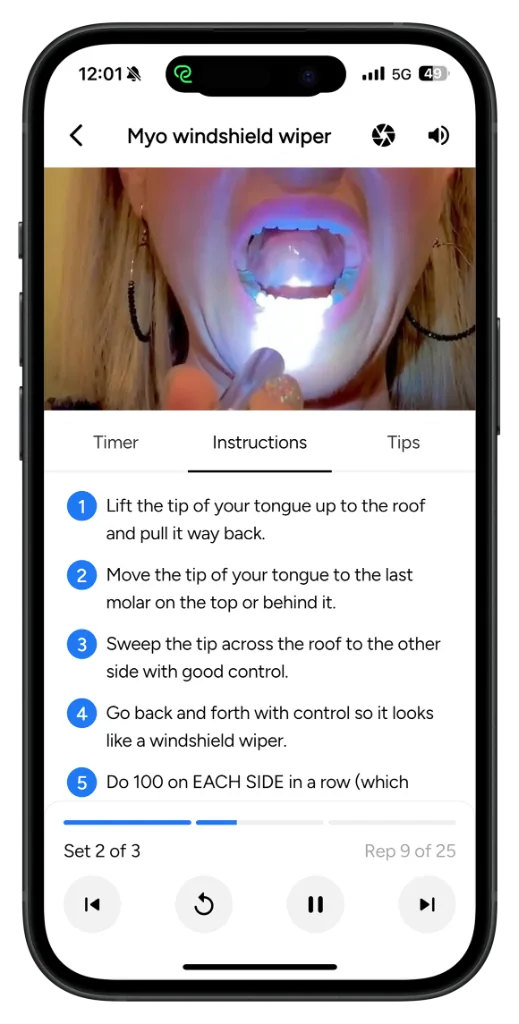
Airway Trainer packages tongue, palate, and throat drills into short guided sessions with timers and progression, because the research pattern is consistency over novelty.
Who should prioritize tongue exercises
You do not need a drug-induced sleep endoscopy to start a sensible routine. These signals help you decide whether tongue work should lead your program.
Likely tongue-heavy snoring
- Closed-mouth, throaty snore that worsens on your back
- Partner hears a deeper "rattle" rather than a nasal whistle
- You wake with a dry mouth even when the nose feels open
Start tongue drills first
- Protrusion + palate suction + tongue pop cover the core openers
- Add cheek resistance and slides once form is clean
- Keep a soft-palate "ah" lift in the mix if snoring also sounds fluttery
Escalate care if...
- Gasping, choking, or witnessed pauses in breathing
- Daytime sleepiness, morning headaches, or high blood pressure
- No change after 8-12 weeks of honest daily practice
9 tongue exercises for snoring
Start gently. These should feel like controlled drills, not a jaw workout that leaves you sore. The first four map closely to ENT and hospital sleep-unit protocols (protrusion, suction, pop, cheek resistance). The rest expand range, coordination, and tone. Pair with soft palate exercises if your snore also sounds fluttery or buzzy.
Exercise 1
Tongue protrusion hold
Genioglossus (forward tongue tone)
- Stick your tongue straight out as far as it comfortably goes.
- Aim toward your nose or chin; hold for about 5 seconds without neck strain.
- Return the tongue, rest, and repeat. Build from 3 reps toward 10 as it gets easy.
Form cue: If a restrictive tongue tie scrapes the underside of the tongue on full protrusion, curl the tongue inside the mouth instead, or press the tip against a spoon for 5-second isometric holds.
Exercise 2
Palate suction hold
Full tongue seal + palatal rest position
- Press the entire tongue flat against the roof of your mouth.
- Create light suction so the tongue stays sealed to the palate.
- Hold 5-10 seconds while breathing through your nose, release, rest, and repeat.
Form cue: Progression: open the mouth slowly while keeping suction, or look slightly up to change the stretch. This is the static cousin of the hospital tongue-pop drill.
Exercise 3
Tongue pop (SingHealth protocol)
Tongue tone + collapsibility + rest position
- Open your mouth. Place the tongue tip behind the upper front teeth and press the whole tongue up to the hard palate.
- Create suction for about 1 second.
- Flick the tongue down sharply so you hear a clean pop. Ten pops, rest 5 seconds, five total sets.
Form cue: Hospital sleep-unit framing: the goal is higher muscle tone, less tongue collapsibility, and a palatal tongue rest position. Aim for a crisp pop, not a wet click.
Exercise 4
Cheek press with resistance
Lateral tongue strength
- Push the tongue firmly into the inside of one cheek.
- Resist with a finger on the outside of the cheek so the tongue works against load.
- Hold a few seconds, switch sides, and build volume over days.
Form cue: Passive cheek stretch alone is weaker training. The finger resistance turns it into strength work on both sides of the tongue.
Exercise 5
Tongue slide
Tongue tip + body contact along the palate
- Place the tip of the tongue behind your top front teeth.
- Slide the tongue backward along the roof of the mouth in a slow, controlled line.
- Return to the start and repeat without rushing.
Form cue: A high-frequency drill across clinical handouts and page-one snoring guides. Keep the jaw relaxed so the tongue does the work.
Exercise 6
Tongue stretch (down / out)
Tongue length and base mobility
- Stick the tongue out as far as comfortable.
- Reach toward the chin while looking slightly up if that deepens the stretch without pain.
- Hold, release, and increase duration over weeks.
Form cue: Pairs with protrusion holds. Stop if you feel sharp pain under the tongue (possible frenulum restriction).
Exercise 7
Tongue aerobics (up / down / left / right)
Full range and tone in every direction
- Reach the tongue up toward the nose and hold about 10 seconds.
- Reach down toward the chin, then left, then right, holding each direction.
- Repeat the cycle for several rounds with short rests.
Form cue: Trains the directions the tongue can fall during sleep. Keep neck muscles quiet; isolate the tongue.
Exercise 8
Tip-to-teeth + swallow
Tongue-throat coordination
- Press the tongue tip against the back of the upper front teeth.
- While holding that contact, initiate a gentle swallow.
- If easy, look slightly up to increase demand. Stay below the gag threshold.
Form cue: From ENT at-home protocols aimed at strengthening coordinated tongue and throat recruitment, not forcing a deep gag.
Exercise 9
High-pitch vowel holds
Tongue, palate, and pharyngeal wall tone
- Say a bright, tense "EEE" or "I" with clear mouth shape.
- Engage throat and neck support without shouting; hold about 5 seconds.
- Cycle through exaggerated A-E-I-O-U shapes, favoring higher-pitch, tighter forms.
Form cue: ENT endoscopic observations favor high-pitch, tense vowels that open space over low-pitch growls that can collapse sidewalls. Demonstration context, not a trial outcome.
Train openers, not closers
Not every mouth movement is useful training for snoring. Modern ENT reasoning (and the design of hypoglossal nerve implants such as Inspire) focuses on vectors that pull the tongue forward and flatter, opening space behind it. Pulling the tongue aggressively backward can feel intense but may train a less useful pattern.
Prioritize
Straight protrusion holds, full-palate suction, tongue pop, lateral cheek resistance, high-pitch tense vowels, and controlled tip-to-teeth swallows below the gag.
Be cautious
Deep tongue-back drills that trigger gagging, low-pitch growls that collapse sidewalls, and any move that scrapes a tight frenulum over the lower teeth.
Endoscopic walkthroughs are demonstration context for form and mechanism. They are not randomized outcomes. Ground expectations in the trial evidence section below.
Video walkthroughs
Use these for movement context and clinician framing. Videos are not clinical citations. Credits: Vik Veer (NHS ENT surgeon, London), SingHealth / Sengkang General Hospital sleep unit.
Vik Veer, ENT surgeon - five tongue/throat drills (~8 minutes)
Vik Veer - longer endoscopic reasoning on openers vs closers
SingHealth - tongue pop protocol (10 reps x 5 sets)
SKH Sleep Unit - Tabata-style tongue strengthening block
Vik Veer - broader myofunctional / throat exercise overview
A simple daily routine
You do not need all nine drills every day on day one. Use a short core, then expand.
- Core (about 8 minutes): protrusion holds, palate suction, tongue pop sets, cheek resistance both sides.
- Add-on (3-5 minutes): tongue slide + one high-pitch vowel block.
- Optional Tabata day: 20 seconds work / 10 seconds rest for 8 rounds on pop or suction (hospital sleep-unit format).
- Weeks 1-4: focus on form and daily completion. Weeks 5-12: add volume and progressive difficulty (longer holds, mouth-open suction).
If you want the lowest-friction version, use Airway Trainer for the daily sequence. It handles reps, timers, and progression so you are not juggling a handout.
Limits and safety
Tongue exercises tend to underperform when snoring is driven mainly by alcohol or sedatives, large tonsils, severe nasal blockage, significant weight-related narrowing, or moderate-to-severe untreated obstructive sleep apnea. In those cases, training can still be an add-on, not the primary plan.
- Stop any drill that causes sharp pain, dizziness, or true gagging.
- Modify for tongue-tie restriction instead of forcing full protrusion.
- Do not use mouth tape to "lock in" results if your nose is blocked.
- Exercises are not a substitute for CPAP or other prescribed apnea therapy.
This page is educational and not medical advice. Talk to a clinician about symptoms that suggest sleep apnea.
What the evidence supports
The strongest clinical data is for multi-structure oropharyngeal / myofunctional programs that include tongue work, not for tongue isolation alone:
- Ieto et al., 2015 (RCT): oropharyngeal exercises reduced snoring frequency and snoring power in habitual snorers.
- Guimaraes et al., 2009 (RCT): upper-airway exercises improved OSA outcomes and snoring versus control.
- Camacho et al., 2015 (meta-analysis): myofunctional therapy associated with reductions in snoring and AHI across pooled trials (often summarized near ~50% AHI change; individual studies vary).
For a broader study-by-study walkthrough, see oropharyngeal exercises clinical studies. For general mouth-exercise framing, see how mouth exercises reduce snoring.
FAQ
Do tongue exercises for snoring actually work?
They can, when weak tongue and upper-airway tone are part of the problem. Randomized trials of oropharyngeal programs that include tongue drills (Ieto 2015, Guimaraes 2009) reduced snoring metrics, and a myofunctional therapy meta-analysis (Camacho 2015) found pooled reductions in snoring and apnea-hypopnea index. Results are not guaranteed, take weeks of daily practice, and do not replace evaluation for moderate-to-severe sleep apnea.
How long until tongue exercises reduce snoring?
Most published programs run about 6 to 12 weeks with daily practice, often 8-30 minutes total depending on the protocol. Some people notice quieter nights sooner; the trial endpoints that matter usually sit near the 3-month mark. Consistency beats intensity.
What is the best single tongue exercise for snoring?
There is no proven one-drill winner. Clinicians often prioritize tongue protrusion (forward tone), full-palate suction or tongue-pop work (rest position and collapsibility), and multi-direction strength. Combined tongue, palate, and throat routines are what the stronger trials tested, not a single viral move.
Are tongue exercises the same as myofunctional therapy?
Tongue exercises are a core slice of myofunctional therapy. Full myofunctional care also covers tongue posture, nasal breathing, swallow, and often posture coaching with a trained therapist. Home drills are a practical start; they do not replace a clinician-led program when one is available.
Can a tongue tie block these exercises?
Yes. A short lingual frenulum can stop straight protrusion and force the tongue to roll down instead of forward. ENT-facing guidance often suggests modified inside-mouth curls or isometric spoon presses, and may refer severe restriction for evaluation. Pain scraping over the lower teeth is a red flag to modify, not push through.
Should I train the tongue forward or pull it backward?
Prioritize forward protrusion, flattening, and palate seal. Hypoglossal nerve stimulation therapies deliberately favor tongue-forward vectors that open space behind the tongue. Aggressive tongue-back drills can feel like they "work the throat" but may train less useful patterns for airway opening. Stay below the gag threshold and favor openers.
How often should I do tongue exercises for snoring?
Daily. A practical floor is about 8-10 minutes (for example, an ENT five-drill set) or two short Tabata-style blocks (20 seconds work / 10 seconds rest, 8 rounds). Split morning and evening if one long session is hard to keep.
When should I see a doctor instead of only doing exercises?
See a clinician if you gasp or choke at night, have witnessed breathing pauses, severe daytime sleepiness, morning headaches, resistant high blood pressure, or if a partner is alarmed by your breathing. Exercises can support care; they should not delay diagnosis or prescribed treatment for sleep apnea.
Sources
- Ieto V, et al. Chest. 2015 Sep;148(3):683-691. PMID: 25950418. - Randomized trial: oropharyngeal exercises (including tongue drills) reduced snoring frequency and snoring power in habitual snorers. Source
- Guimaraes KC, et al. Am J Respir Crit Care Med. 2009 May 15;179(10):962-968. PMID: 19234106. - Randomized trial: upper-airway (tongue, palate, throat) exercises improved obstructive sleep apnea outcomes and snoring. Source
- Camacho M, et al. Sleep. 2015 May 1;38(5):669-675. PMID: 25348130. - Meta-analysis of myofunctional therapy for OSA: pooled trials show meaningful reductions in snoring and apnea-hypopnea index (~50% range across analyses). Source
- Goswami U, et al. Sleep Breath. 2019 Mar;23(1):243-250. PMID: 30032464. - Smartphone-guided oropharyngeal exercise delivery for snoring. Source
- Torbay and South Devon NHS Foundation Trust. - Patient handout: soft palate and tongue exercises for snoring. Source
- Veer V. ENT Surgeon (NHS), London. Clinical exercise walkthroughs. - Demonstration context only: ENT-led tongue and throat exercise protocols for NHS snoring/apnea patients; not a clinical citation. Source
- Sengkang General Hospital / SingHealth Sleep Unit. - Demonstration context only: hospital sleep-unit tongue-pop and Tabata-style myofunctional demos. Source
Ready to train the airway, not just silence the room
Airway Trainer gives you a short daily plan with tongue, palate, and throat drills, timers, and progression so the hard part is not remembering what to do next.
Related: airway training for snoring · mouth exercises for snoring · oropharyngeal exercises · soft palate exercises