Deviated septum and snoring
A crooked septum can worsen snoring - it rarely is the whole snore. Here is how nasal blockage amplifies throat vibration, what trials show for septoplasty and sleep apnea, and when clearing the nose still leaves work for airway muscle training.


Quick answer
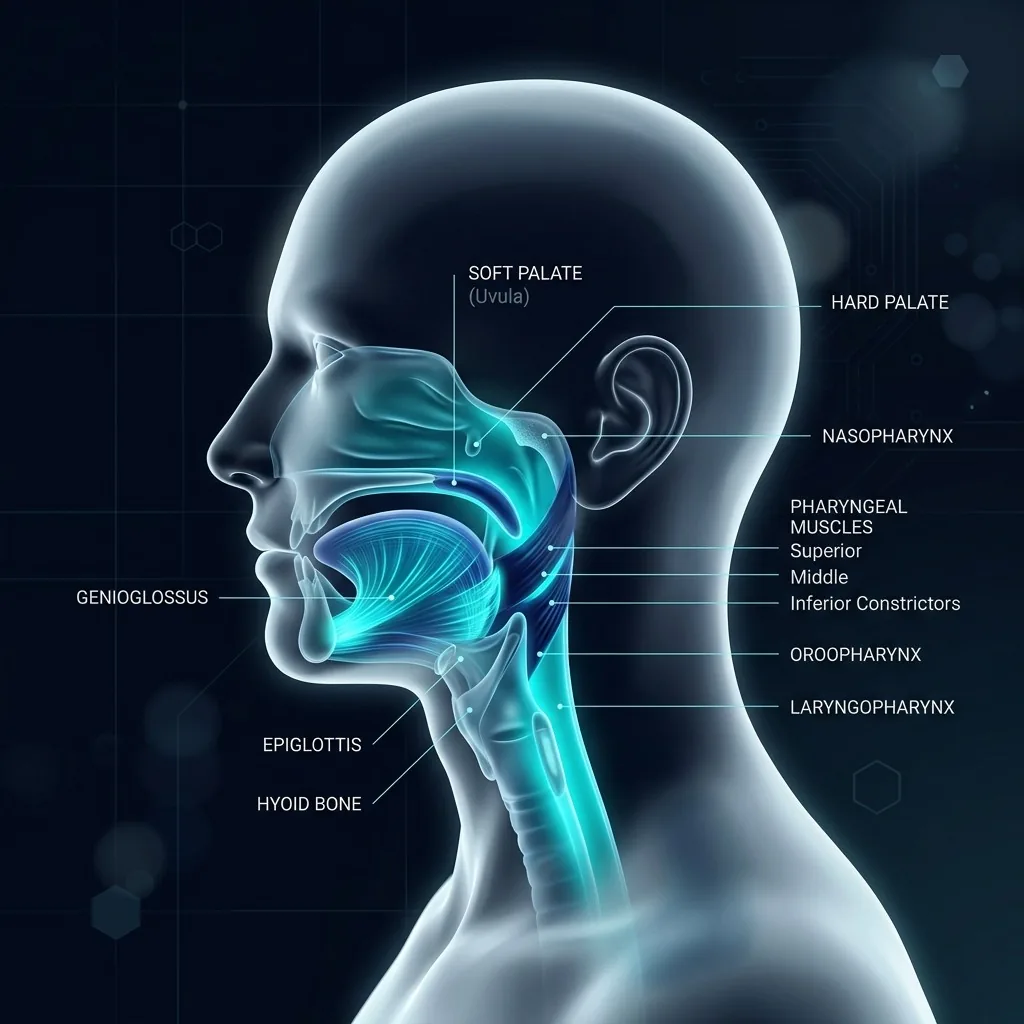
A deviated septum can contribute to snoring, but it is usually an amplifier - not the generator of the sound. Mayo Clinic lists chronic nasal congestion or a crooked nasal septum among factors that may contribute to snoring. The vibration that partners hear still comes from relaxed soft palate, tongue, and throat tissue.
Large cohort data associate septal deviation coding with higher later OSA diagnosis rates (hazard ratio about 4.4 in one national study). A randomized septoplasty-versus-sham trial found isolated nasal surgery rarely cured OSA (about 15% responders). Meta-analyses show only modest average AHI drops after isolated nasal surgery, while NOSE scores for nasal blockage often improve a lot. Treat a blocked nose when it is real - and still plan for throat-level causes when snoring continues.
How a deviated septum links to snoring
The septum is the wall of cartilage and bone that divides the left and right nasal cavities. Almost nobody has a perfectly straight one. A clinically important deviation is one that meaningfully narrows airflow, often with swollen turbinates or allergy edema stacked on top.
Snoring is vibrating soft tissue in a narrowed pharyngeal airway. A blocked nose does not vibrate like a soft palate. It changes the breathing route and the pressure physics: higher nasal resistance means harder inspiratory effort, more mouth opening, and more collapse risk downstream. ENT clinicians often describe this as influence, not root cause - the same framing you hear when colds make snoring temporarily worse.
Amplifier, not the snore generator
Blocked nose raises suction downstream
When the nasal airway is narrow, you generate a larger pressure drop to pull air in. That extra suction can make already-floppy tongue and soft-palate tissue collapse and vibrate harder. Mayo Clinic lists a deviated septum among nasal problems that contribute to snoring - contribution, not sole cause.
Common bridge to throat snoring
Mouth breathing drops the jaw and tongue
A chronically stuffy nose pushes sleep breathing through the mouth. An open jaw lets the tongue fall back into the pharynx. Fixing nasal airflow can reduce that cascade even when the vibrating tissues are still in the throat.
Almost never one structure alone
Septum plus turbinates plus allergies
Most people have some septal curve. What blocks airflow is often the combination of curve, swollen turbinates, allergy or cold edema, and sometimes weak nasal side walls. A scan label of "deviated septum" is not a full diagnosis of why you snore.
Enabler more than cure
Nasal patency helps CPAP and other tools
Better nasal breathing often makes nasal-mask CPAP more tolerable, supports oral appliances, and reduces the need to mouth-breathe under positive pressure. That is a real clinical win even when AHI barely moves after isolated nasal surgery.
What the studies show
Clinic guidance is clear that nasal structure can feed snoring without being the only site of vibration. Mayo Clinic names a deviated nasal septum among nasal problems that may contribute, while describing snoring itself as airflow past relaxed tongue, soft palate, and airway tissue.
On population association, Yeom and colleagues (2021; PMID 34606442) followed a large Korean insurance cohort. People with coded septal deviation had a hazard ratio of 4.39 (95% CI 3.56-5.42) for a later OSA diagnosis versus matched controls. Within the septal-deviation group, septoplasty was associated with a lower subsequent OSA hazard (HR 0.71, 95% CI 0.54-0.94). Read that as association and coding-based diagnosis risk, not as "every crooked septum causes apnea" or "surgery always prevents OSA."
On treatment expectations, Koutsourelakis and colleagues (2008; PMID 17898015) randomized 49 OSA patients with fixed septal obstruction to real septoplasty or sham surgery. Mean baseline AHI was about 30 events per hour. Zero sham patients were responders. Only 4 of 27 surgery patients (14.8%) were. The authors concluded isolated nasal surgery rarely treats OSA effectively, though patients who gained the most nasal breathing epochs improved AHI more.
Broader evidence is consistent with modest objective gains. A 2017 meta-analysis of isolated nasal surgery for OSA (Wu and colleagues; PMC5293463) found an overall AHI weighted mean difference near -4 events per hour and better Epworth sleepiness scores. A 2022 systematic review (Schoonbaert and colleagues; PMC9688553) argued that slight AHI decreases are usually not clinically decisive and that isolated nasal surgery should not be first-line OSA therapy - while still noting subjective sleep quality and CPAP-support roles.
Where septoplasty shines is nasal symptom relief. Alessandri-Bonetti and colleagues (2023; PMID 37017244) pooled NOSE scores after septoplasty with or without turbinate work: mean difference about -49 points at six months from a baseline near 68. That is a large patient-reported win for blockage and quality of life - a different endpoint than silencing throat snoring.
Bottom line: fix a truly obstructed nose for comfort, mouth-breathing control, and therapy enablement. Do not expect septoplasty alone to retire moderate or severe OSA, and do not ignore tongue and soft-palate collapse when the nose is already open.
Who is most affected by septum-related snoring
When a septum story is more plausible
- Daytime one-sided or both-sided nasal blockage that never fully clears
- Snoring spikes with colds, allergies, or nights you cannot breathe through the nose
- You mouth-breathe in sleep and wake with a dry mouth
- CPAP leaks, high pressures, or mask removal tied to nasal stuffiness
When the nose is probably not the whole story
- Loud snoring with a clear nose on most nights
- Witnessed pauses, gasping, or severe daytime sleepiness
- Large tongue base, long soft palate, or heavy positional snoring on the back
- Prior septoplasty with open nose but unchanged snoring
See an ENT or sleep clinician first if...
- Gasping, choking, or partner-reported breathing stops
- Morning headaches, resistant high blood pressure, or crashing sleepiness
- Recent nasal trauma, recurrent sinus infections, or suspected polyps
- You are considering surgery mainly to "cure snoring" without a sleep evaluation
Practical next steps if you suspect a septum problem
Treat reversible nasal load first
Allergy control, saline rinses, and clinician-guided nasal sprays can shrink turbinates enough to test whether better nasal airflow changes snoring. Many people improve nights before anyone discusses a knife.
Try temporary nasal openers as a cheap phenotype test
External strips or internal dilators open the nasal valve for a few nights. If snoring barely changes with a clearly open nose, the main vibration is likely further back. If nights get quieter, nasal contribution is real - still not proof surgery is required.
Do not tape a blocked nose shut
Mouth tape assumes you can safely breathe through the nose. With a major deviation, polyps, or active congestion, sealing the mouth can be uncomfortable or unsafe. Clear the nasal path first.
Stack throat-level training once the nose is usable
When you can nasal-breathe, tongue, soft-palate, and throat exercises raise baseline tone so suction and sleep-related relaxation cause less flutter. Nose first when blocked; muscle training for the tissue that actually vibrates.
Related device and habit pages: nasal dilators, nasal strips, mouth taping, and mouth-breathing exercises.
Expert videos on septum, snoring, and nasal breathing
Demonstration and clinician framing only. Clinical claims on this page are grounded in the Sources list, not in video captions.
Young H. An, MD (ENT of Georgia South) - board-certified ENT myth-bust: septoplasty opens the nose; snoring and apnea still originate in floppy tongue and palate, with nasal blockage as an influencing suction load.
Steven Park, MD - why "everyone has a deviated septum," how turbinates, nasal cycle, allergies, and weak nostrils share blame, and why a septum label is incomplete without the full nasal exam.
Mark Weidenbecher, MD - septoplasty as OSA enabler: better nasal route for CPAP comfort, less mouth-breathing tongue fall-back, and stronger support for oral appliances and other therapies - not a standalone apnea cure.
Vik Veer, NHS ENT surgeon - why nasal straightness and turbinate control matter before throat surgery or when CPAP fails from nasal blockage, including night-time function versus "looks fine in clinic."
Fauquier ENT - concise anatomic animation of septoplasty: what is straightened inside the nose and what the operation is designed to change (nasal airflow path, not throat muscle tone).
When airway exercises still help
Opening the nose removes resistance and mouth-breathing load. It does not rebuild tongue or soft-palate strength. If you still snore after the nasal path is clear - or your ENT says the septum is mild - the vibrating tissues need their own plan.
Randomized trials of tongue, palate, and throat exercise programs reduced snoring metrics (Ieto 2015) and improved OSA outcomes versus sham (Guimaraes 2009). A myofunctional therapy meta-analysis (Camacho 2015) found pooled reductions in snoring and apnea-hypopnea index. These programs do not straighten cartilage, and they do not replace CPAP or medical care for significant apnea.
A practical stack for many septum-plus-snoring patients: clear reversible nasal load (and get structural care when indicated), side sleep so gravity is not stacking with low tone, and a short daily airway routine so the tongue and soft palate hold better once you can nasal-breathe. Explore tongue exercises, soft-palate drills, and throat exercises.
Airway Trainer turns those drills into a guided daily session so a clearer nose is not your only lever.
When to see a doctor first
Nasal sprays, dilators, and home exercises are not a substitute for ENT or sleep evaluation when red flags are present. Get assessed - do not only self-label a "deviated septum from a walk-in comment" - if you have:
- Gasping, choking, or witnessed pauses in breathing
- Loud snoring with severe daytime sleepiness or morning headaches
- One-sided blockage after trauma, recurrent sinus disease, or suspected polyps
- Plans for snoring surgery without a sleep study when apnea is possible
Nasal surgery, CPAP, oral appliances, positional therapy, weight management, and airway exercises each solve different pieces. Match the tool to the level of obstruction after a real assessment.
Sources
- Mayo Clinic. Snoring: Symptoms and causes.
Clinical overview: nasal problems such as chronic congestion or a crooked partition between the nostrils (deviated nasal septum) may contribute to snoring; the vibrating tissue that makes the sound is still in the throat. - Mayo Clinic. Obstructive sleep apnea: Diagnosis and treatment.
OSA overview: multilevel upper-airway obstruction; nasal obstruction can worsen mouth breathing and make CPAP harder to tolerate, so nasal care is often part of a broader plan rather than a standalone cure. - Yeom SW, et al. J Clin Sleep Med. 2021 Oct 1;17(10):2099-2106. PMID: 34606442.
Nationwide 9-year cohort (SD n=11,238; matched controls n=22,476): hazard ratio for an OSA diagnosis in the septal-deviation group was 4.39 (95% CI 3.56-5.42). Within the SD group, hazard for OSA after septoplasty was 0.71 (95% CI 0.54-0.94). Association and coding-based diagnosis, not proof that every crooked septum causes apnea. - Koutsourelakis I, et al. Eur Respir J. 2008;31(1):110-117. PMID: 17898015.
Randomized trial of septoplasty vs sham surgery in 49 OSA patients with fixed nasal obstruction from septal deviation (mean AHI about 30). All sham patients were nonresponders; only 4 of 27 surgery patients (14.8%) were responders. Authors concluded isolated nasal surgery rarely treats OSA effectively; higher nasal breathing epochs predicted better AHI change. - Wu J, et al. Medicine (Baltimore). 2017 Feb;96(5):e6008. PMID: 28151900. PMC: PMC5293463.
Meta-analysis of isolated nasal surgery for OSA (18 studies, 587 participants): overall AHI weighted mean difference about -4.15 events/hour and ESS improvement about -4 points. Statistically significant but modest AHI change - not a primary standalone OSA cure for most patients. - Schoonbaert I, et al. Brain Sci. 2022 Oct 26;12(11):1446. PMID: 36358396. PMC: PMC9688553.
Systematic review of isolated nasal surgery in adult OSA: most included studies did not show a clinically meaningful AHI drop; meta-analysis suggested only a slight AHI decrease. Authors advise against isolated nasal surgery as first-line OSA treatment, while noting possible subjective benefit and CPAP support roles. - Alessandri-Bonetti M, et al. Laryngoscope. 2023 Dec;133(12):3237-3246. PMID: 37017244.
Systematic review and meta-analysis of septoplasty with or without turbinate surgery for nasal obstruction (NOSE score): pooled baseline NOSE about 68; mean difference at 6 months about -49 points. Strong patient-reported relief of nasal blockage - a different outcome than curing throat-based snoring. - Ieto V, et al. Chest. 2015 Sep;148(3):683-691. PMID: 25950418.
Randomized trial: oropharyngeal (airway) exercises reduced snoring frequency and snoring power in habitual snorers - a throat-level approach when the nose is only part of the story. - Guimaraes KC, et al. Am J Respir Crit Care Med. 2009 May 15;179(10):962-968. PMID: 19234106.
Randomized trial: daily upper-airway exercises improved obstructive sleep apnea severity and snoring versus sham control. - Camacho M, et al. Sleep. 2015 May 1;38(5):669-675. PMID: 25348130.
Meta-analysis of myofunctional therapy for OSA: pooled trials show meaningful reductions in snoring and apnea-hypopnea index when tongue, palate, and throat tone are trained.
Deviated septum and snoring: FAQs
Does a deviated septum cause snoring?
It can contribute, but it is rarely the sole cause. Mayo Clinic lists a crooked nasal septum among nasal problems that may contribute to snoring. The snore sound still comes from vibrating throat tissues. A blocked nose raises suction and promotes mouth breathing, which can make tongue and soft-palate flutter worse. Many people have some septal curve and do not snore.
Will septoplasty cure my snoring?
Usually not by itself. A randomized trial of septoplasty versus sham surgery in OSA patients with fixed septal obstruction found only about 15% of surgery patients met responder criteria, and no sham patients did (Koutsourelakis 2008). Systematic reviews of isolated nasal surgery show little to modest average AHI change and advise against nasal surgery as first-line OSA therapy. Septoplasty often greatly improves nasal blockage scores (NOSE meta-analysis), which is a different goal than silencing throat snoring.
Can a deviated septum cause sleep apnea?
It is associated with higher odds of an OSA diagnosis in large cohort data, and severe bilateral nasal compromise can worsen multilevel obstruction, but the main collapsible sites in OSA are usually the soft palate and tongue base. A Korean national cohort found a hazard ratio of about 4.4 for OSA diagnosis among people coded with septal deviation versus matched controls, with lower hazard after septoplasty (Yeom 2021). That is association and claims-coding, not proof every septum curve causes apnea. Get a proper sleep evaluation if red flags are present.
Why do I snore more when I have a cold if my septum is the issue?
Temporary swelling stacks on top of a fixed curve. Extra nasal resistance increases the suction load on the throat, so the same soft palate that was quiet last week can vibrate loudly. That pattern shows the nose is an amplifier. It still does not mean the vibrating generator lives in the septum.
Should I fix my nose before CPAP or oral appliances?
Often yes if nasal blockage is real. Better nasal patency can make nasal-mask CPAP more comfortable, reduce mouth leak, and help other therapies work more smoothly. That is a support role: enable first-line OSA therapy, not replace it when AHI is high. Discuss timing with your sleep and ENT teams.
Can nasal dilators or strips replace surgery for a deviated septum?
They are a temporary mechanical open of the nasal valve, not a structural repair of cartilage and bone. They can test whether better nasal airflow changes snoring and may help mild valve collapse. Significant fixed deviation, severe turbinate hypertrophy, or polyps still need clinical assessment. See our nasal dilators insight for device-level evidence.
Can airway exercises help if I have a deviated septum?
Exercises train tongue, palate, and throat tone. They do not straighten cartilage. If your nose is severely blocked, open or medically manage the nose first so you can nasal-breathe; then train the tissues that vibrate. Randomized trials (Ieto 2015, Guimaraes 2009) and a myofunctional meta-analysis (Camacho 2015) support exercise programs for snoring and selected OSA cases. They are not a substitute for ENT care or sleep-apnea evaluation.
A clearer nose is only half the stack
Treat real nasal obstruction with the right medical or surgical plan. Airway Trainer handles the daily tongue, palate, and throat work that keeps the airway stiffer when suction and sleep still challenge soft tissue - the piece septum surgery alone cannot train.
Related reading: Do nasal dilators work? · Mouth-breathing exercises · Oropharyngeal exercise studies