Best sleeping position for snoring
Side sleeping is the best default for most snorers. Back sleep lets gravity drop the tongue and soft palate into the airway. Here is how position-dependent snoring works, what positional therapy studies actually show, how to stay on your side, and when training airway muscles matters more than another pillow.


Quick answer
Sleep on your side, not your back. Back sleep is usually the noisiest position because gravity pulls the tongue and soft palate toward the rear wall of the throat. Mayo Clinic lists avoiding back sleep among the first lifestyle steps for snoring. A gentle head-of-bed elevation can help as a secondary tweak.
Position change works best when snoring is clearly worse on your back. Reviews of positional therapy for position-dependent obstructive sleep apnea show meaningful short-term drops in apnea events and supine time in selected patients, while CPAP still tends to lower the apnea-hypopnea index more. If you snore in every position, or you have apnea warning signs, position alone is not enough - evaluate the airway and consider training or medical care.
Sleeping positions ranked for snoring
Best default for snoring
Side sleeping (left or right)
Keeps gravity from dropping the tongue and soft palate straight into the airway. Mayo Clinic lists side sleeping as a first lifestyle step. For acid reflux, many clinicians prefer the left side; for apnea control alone, comfort and staying off the back matter more than left vs right.
Usually worst
Back (supine)
The jaw and tongue can fall backward under gravity, narrowing the throat. This is why many people only snore hard on their back and why sleep studies can look mild or severe depending on the night if you flip between positions.
Useful add-on
Slight head-of-bed elevation
Raising the whole bed frame or using a gentle wedge (not a giant pillow that kinks the neck) can reduce airway collapse and help sinus drainage. Pair elevation with side sleeping when you can; do not use a tall pillow that pushes the chin toward the chest.
Sometimes quieter, not ideal long term
Stomach sleeping
The airway may stay more open than on the back, but neck twist and chest pressure make this a poor default for many people. If it is the only position that quiets you, treat it as a temporary bridge while you train side sleeping and airway tone.
Why back sleep makes snoring worse
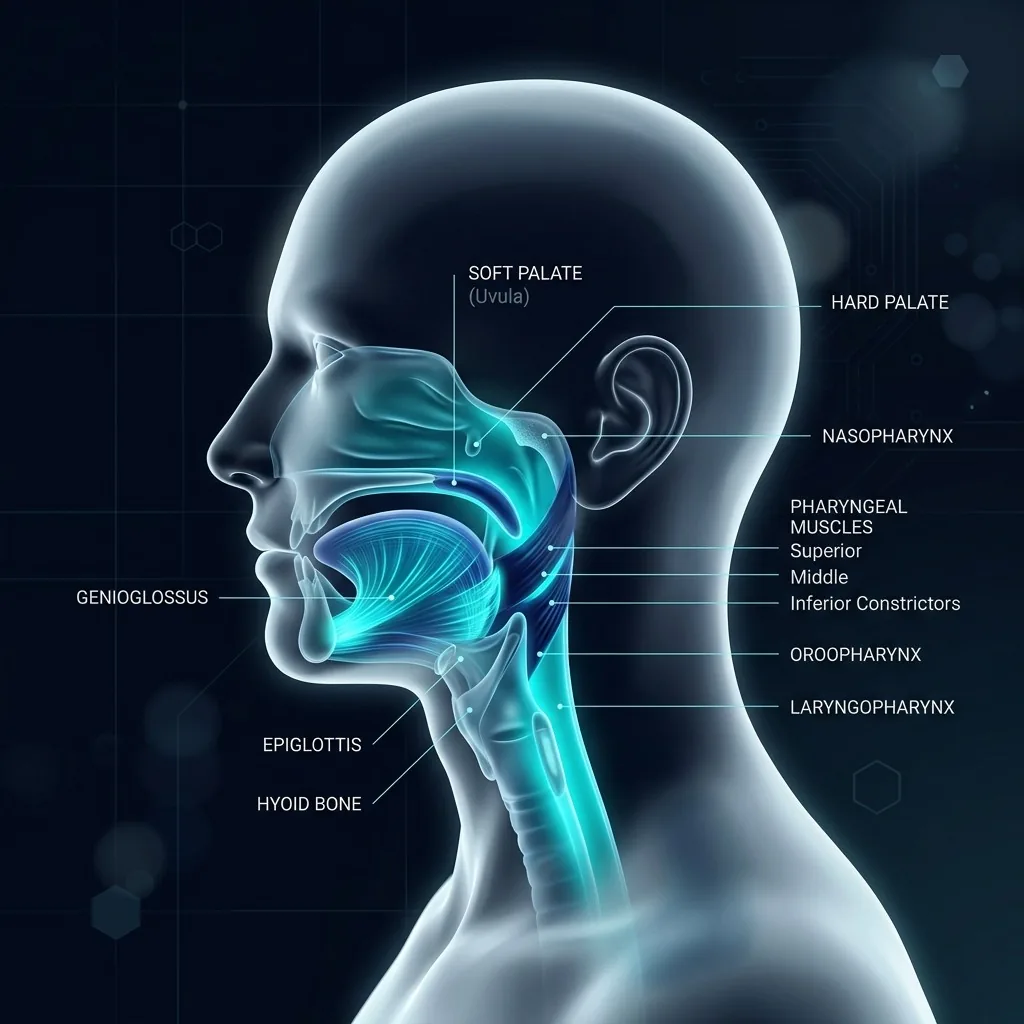
Snoring is vibrating soft tissue in a narrowed airway. During sleep, muscle tone falls in the tongue, soft palate, and pharyngeal walls. On your back, gravity adds a second problem: the tongue and jaw can slide backward into the throat, so the same loose tissue has less room and more reason to flutter.
That is also why some people get confusing sleep-study nights. If you mostly slept on your side during testing, a severe back-sleep problem can look mild. If you spent the night flat on your spine, mild positional disease can look severe. ENT surgeons who specialize in sleep surgery describe this pattern as positional obstructive sleep apnea: much worse when supine, much better on the side, often driven by tongue-base collapse.
Side sleeping does not rebuild muscle. It changes the direction of gravity so the jaw and tongue are less likely to fall straight into the airway. That is why partners have rolled snorers onto their sides for decades - and why modern positional therapy tries to make that roll automatic without a bruise from a tennis ball.
Who benefits from changing sleep position
Likely to improve with position change
- You (or a partner) notice snoring mainly on your back
- A sleep study shows much higher AHI when supine than on your side (positional OSA pattern)
- Primary snoring without gasping, choking, or severe daytime sleepiness
- You can learn side sleeping with a pillow wall or gentle trainer over a few weeks
Limited benefit from position alone
- You snore loudly in every position, including side sleep
- Moderate-to-severe untreated obstructive sleep apnea
- Major nasal blockage that forces mouth breathing regardless of position
- Significant weight-related soft-tissue narrowing around the airway
See a clinician first if...
- Gasping, choking, or witnessed pauses in breathing
- Morning headaches, resistant high blood pressure, or severe daytime sleepiness
- You need alcohol or sedatives most nights to fall asleep
- A wearable or partner report suggests apnea and you have never been evaluated
How to stay on your side all night
Build a side-sleep setup
Use a thicker pillow so the neck stays neutral on your side, put a pillow between the knees, and place a firm pillow or body pillow behind your back so rolling onto your spine is harder. NHS ENT surgeon Vik Veer notes that thin pillows often cause neck pain and a dead arm on the side, which pushes people back onto their backs.
Train the habit for 4-6 weeks
Side sleeping is a skill. Give yourself several weeks of consistent cues (pillow wall, backpack-style trainer, or vibrotactile belt) before deciding it "does not work." The goal is a recovery-like position where the jaw and tongue fall slightly forward, not a three-quarter twist that still lets the tongue drop back.
Skip bruised tennis-ball hacks if they fail
Sewing a tennis ball into pajama backs is a classic DIY method Mayo Clinic still mentions, but many people simply bruise themselves and still end up supine. Modern options include larger foam backpacks or neck/chest vibration devices studied in positional OSA trials.
Stack the non-position basics
Avoid alcohol near bedtime, treat nasal congestion, and keep a regular sleep window. Alcohol softens the palate and makes back-sleep collapse worse. Position change works better when you are not stacking muscle-relaxing triggers on top of gravity.
Avoid a huge stack of pillows under the head alone. That can flex the neck forward and narrow the airway. Prefer a gentle incline from hips to head, or a wedge that lifts the torso, then keep the neck neutral on a side-sleep pillow.
What the studies show
Position matters for a large share of people with obstructive sleep apnea. A 2017 systematic review and meta-analysis of newer positional-therapy devices (Ravesloot and colleagues) noted that body position influences apnea frequency in roughly 56% to 75% of OSA patients. Across short-term studies of those devices, pooled data showed about an 11-event-per-hour AHI drop (about 54%) and an 84% reduction in supine sleep time.
A 2019 Cochrane review compared positional therapy with CPAP and with inactive control. Versus no positional therapy, position strategies improved AHI and Epworth Sleepiness Scale scores. Versus CPAP, CPAP still reduced AHI more (about 6.4 events/hour better in the pooled comparison), while short-term self-reported adherence sometimes favored positional devices. Certainty of evidence was low to moderate, and study durations were short.
Longer sham-controlled data are starting to catch up. A multicentre randomized trial published in Thorax (Kelly and colleagues; NCT04153240) tested a neck-worn vibrotactile device against sham for three months in positional OSA. Active therapy lowered AHI by about 4.4 events/hour versus sham (about a 34% relative improvement) and improved sleep-quality scores. Bed partners reported less snoring. Daytime sleepiness did not improve significantly in that trial, which is a useful reminder: quieter nights are not automatic proof that every symptom is fixed.
Bottom line from the literature: side-oriented positional therapy is a real tool for the right phenotype, not a meme. It is less potent than CPAP for lowering AHI, works best when disease is clearly worse on the back, and still leaves room for airway-muscle training and medical care when collapse is not position-only.
Expert videos on position and snoring
Demonstration and clinician framing only. Clinical claims on this page are grounded in the Sources list, not in video captions.
Vik Veer, ENT surgeon (NHS, Royal National ENT Hospital) - positional OSA explained, tongue-base gravity, 4-6 week side-sleep training, and why small tennis-ball hacks often fail.
CPAP Reviews - practical walkthrough of supine vs side vs stomach, gentle elevation without kinked-neck pillows, and left-side preference when reflux is in play.
YOGABODY (Lucas Rockwood) - why flat back sleep is a poor default for breathing, side-sleep pillow setup, and elevated Fowler-style options when side sleep is hard.
Hospital clinician short - nose-to-throat ladder for snoring care, including position change, alcohol timing, weight, and when jaw or palate issues need ENT or dental input.
Dr. Lakshmi Ponnathpur, ENT - brief explanation of soft palate, uvula, and tongue-base fall on the back, plus the classic side-sleep cue.
When airway exercises help more than pillows
Position therapy rearranges gravity for one night at a time. If you roll onto your back, the problem returns. If you snore on your side too, gravity was never the whole story - the tissues themselves are too loose or too bulky for the airway space you have.
A contour, wedge, or smart pillow can make side sleep easier for the right person, but it is still a positional aid. See the evidence and a practical trial plan in our anti-snoring pillow guide.
That is where oropharyngeal and myofunctional exercises come in. Randomized trials of tongue, palate, and throat exercise programs reduced snoring metrics (Ieto 2015) and improved OSA outcomes versus sham (Guimaraes 2009). A myofunctional therapy meta-analysis (Camacho 2015) found pooled reductions in snoring and apnea-hypopnea index across studies. These programs do not replace CPAP or medical care for significant apnea, but they target the muscle tone that position change never trains.
A practical stack for many positional snorers: side sleep for immediate quieter nights, skip late alcohol, clear the nose if it is blocked, and run a short daily airway routine so the tongue and soft palate hold better even when you inevitably roll. Explore related guides on tongue exercises, soft-palate drills, and throat exercises.
Airway Trainer turns those drills into a guided daily session so side sleep is not your only lever.
When to see a doctor first
Changing sleep position is safe for most healthy adults, but quieter snoring is not the same as treating obstructive sleep apnea. Cleveland Clinic notes that OSA interrupts restorative sleep and can stress the heart when untreated. Get evaluated - do not only buy another pillow - if you have:
- Gasping, choking, or witnessed pauses in breathing
- Loud snoring in every position with daytime sleepiness
- Morning headaches or resistant high blood pressure
- A partner who says you stop breathing on your side too
Position therapy, oral appliances, CPAP, nasal care, and airway exercises each solve different pieces of the problem. Match the tool to the cause after a real assessment when red flags are present.
Sources
- Mayo Clinic. Snoring: Diagnosis and treatment (lifestyle remedies).
Clinical guidance: avoid sleeping on your back because the tongue can fall backward and narrow the airway; side sleeping and raising the head of the bed are standard first-line lifestyle steps. - Cleveland Clinic. Sleep Apnea. Last reviewed January 2025.
Overview of obstructive sleep apnea mechanisms and management options, including changing sleep position so you are not on your back. - Ravesloot MJL, et al. J Clin Sleep Med. 2017 Jun 15;13(6):813-824. PMID: 28212691.
Systematic review and meta-analysis of newer positional-therapy devices for position-dependent OSA: roughly 56% to 75% of OSA cases are influenced by body position; pooled short-term data showed about a 54% AHI drop and an 84% reduction in supine sleep time. - Srijithesh PR, et al. Cochrane Database Syst Rev. 2019 May 1;5(5):CD010990. PMID: 31041813.
Cochrane review: positional therapy beat inactive control on AHI and sleepiness scores, but CPAP reduced AHI more than positional therapy; short-term self-reported adherence sometimes favored positional devices. - Kelly JL, et al. Thorax. 2026 Mar 13;81(4):370-379. PMID: 40992934. NCT04153240.
Multicentre RCT of neck-worn vibrotactile positional therapy vs sham over 3 months in positional OSA: AHI fell about 4.4 events/hour vs sham (about 34% relative improvement); bed partners reported less snoring and better sleep quality. - Ieto V, et al. Chest. 2015 Sep;148(3):683-691. PMID: 25950418.
Randomized trial: oropharyngeal (airway) exercises reduced snoring frequency and snoring power in habitual snorers. - Guimaraes KC, et al. Am J Respir Crit Care Med. 2009 May 15;179(10):962-968. PMID: 19234106.
Randomized trial: daily upper-airway exercises improved obstructive sleep apnea severity and snoring versus sham control. - Camacho M, et al. Sleep. 2015 May 1;38(5):669-675. PMID: 25348130.
Meta-analysis of myofunctional therapy for OSA: pooled trials show meaningful reductions in snoring and apnea-hypopnea index.
Best sleeping position for snoring: FAQs
What is the best sleeping position for snoring?
Side sleeping is the best default for most snorers. Lying on your back lets the tongue and soft palate fall backward into the airway, which is why Mayo Clinic lists avoiding back sleep as a core lifestyle step. A slight whole-body elevation can help as an add-on. Stomach sleeping sometimes quiets snoring but is often hard on the neck and is not the first recommendation.
Why do I only snore on my back?
In back sleep, gravity pulls the tongue and jaw toward the rear wall of the throat. If those tissues are already loose or large, the airway narrows and soft tissue vibrates. On your side, the jaw and tongue can fall slightly forward instead of straight back, which is why many people have much quieter nights when they stay off their spine. When the same pattern shows up on a sleep study (high AHI on the back, much lower on the side), clinicians call it position-dependent or positional OSA.
Does side sleeping fix sleep apnea?
It can substantially reduce events for people with true positional OSA, but it is not a cure-all and it is not a substitute for evaluation when apnea is suspected. A 2017 meta-analysis of newer positional-therapy devices found large short-term drops in AHI and supine time in selected patients. A 2019 Cochrane review found positional therapy better than no therapy for AHI and sleepiness, while CPAP still reduced AHI more. If you gasp, choke, or feel exhausted despite quieter snoring, get a sleep evaluation.
Is left side better than right side for snoring?
For pure snoring and apnea control, the evidence does not crown one side as clearly superior for everyone. For people with acid reflux, many clinicians prefer left-side sleep because right-side sleep can worsen reflux symptoms. Choose the side you can sustain all night without rolling onto your back.
Do positional pillows and vibration devices work?
They can, when your problem is mostly supine. Meta-analysis data on vibrotactile and similar new-generation devices show large short-term reductions in supine sleep and AHI in positional OSA. A 2026 multicentre RCT of a neck-worn vibrotactile device vs sham found about a 34% AHI improvement and partner-reported snoring gains over three months. Devices help you stay off your back; they do not strengthen the airway muscles that collapse in every position.
How is sleeping position different from airway exercises?
Position change is a nightly mechanical strategy: you rearrange gravity so the tongue is less likely to fall backward. Airway exercises (myofunctional or oropharyngeal training) try to raise baseline muscle tone in the tongue, soft palate, and throat so the airway stays more open even when muscle tone drops in sleep. Randomized trials (Ieto 2015, Guimaraes 2009) and a myofunctional therapy meta-analysis (Camacho 2015) support exercise programs for snoring and selected OSA cases. Many people do both: side sleep for immediate relief, exercises for durable tone.
When should I see a doctor instead of only changing positions?
See a clinician if you have gasping or choking, witnessed breathing pauses, severe daytime sleepiness, morning headaches, resistant high blood pressure, or snoring that is loud in every position. Position change can mask or only partly treat obstructive sleep apnea. Cleveland Clinic notes that untreated OSA stresses the heart and disrupts restorative sleep. Screening tools and a formal sleep evaluation matter more than another pillow experiment when red flags are present.
Quieter nights take more than one good pillow
Side sleep handles gravity. Airway Trainer handles the daily tongue, palate, and throat work that keeps the airway stiffer when muscle tone drops - the piece position change cannot train.
Related reading: Do anti-snoring devices work? · Mouth breathing exercises · Oropharyngeal exercise studies · What causes snoring in women · Pregnancy snoring