Mouth exercises can reshape the airway
Most advice about mouth exercises for snoring stops at "they help." A 2026 study went further. Researchers scanned the tongue with ultrasound before and after three months of daily exercises. The tongue got smaller. It also got stronger. And the airway behind it opened up. Here is what the study found, and what it does not prove.
1. What the 2026 study measured
2. Why a smaller, stronger tongue helps
3. The earlier trials that back it up
4. What the study does not prove
5. Who it fits, and who should see a doctor first
6. Frequently asked questions
A controlled trial used ultrasound to measure the tongue before and after three months of daily mouth exercises.
The fall in tongue volume in the exercise group. Tongue thickness dropped about 4 mm. Both results were statistically significant.
How far the apnea-hypopnea index fell in an earlier app-based trial from the same research group.
The daily dose, most days of the week. People did the routines at home and were checked over video, not in a clinic.
What the study measured
Plenty of studies say mouth exercises reduce snoring. Very few show why. The usual explanation is that the muscles get stronger. That is true, but it is hard to see. You cannot watch a tongue get fitter.
A 2026 trial changed that. A team led by Cristina Rodriguez-Alcala followed 60 adults with obstructive sleep apnea for three months. One group did daily oropharyngeal exercises. Those are targeted drills for the tongue, soft palate, and throat. The catch: the exercises were guided over video, not taught in a clinic. Before and after, the researchers scanned each person's tongue with ultrasound.
What changed after three months
Tongue volume
Down 8 cm³ in the moderate-apnea exercise group. The tongue took up less room at the back of the mouth.
Tongue thickness
Down about 4 mm on ultrasound. A thinner tongue base sits further from the back of the throat.
Tongue strength
Measured with a pressure sensor. Strength went up as size went down. The muscle got firmer, not weaker.
Airway shape
Checked with a sleep endoscopy. The space behind the tongue was less prone to closing.
The headline number is the tongue volume. It dropped by 8 cm³ in the moderate-apnea group, and the result was statistically significant. The tongue did not waste away. Its strength went up. It lost the bulk that gets in the way and kept the muscle that holds it in place. The study was published in the Journal of Clinical Sleep Medicine in 2026.
Why a smaller, stronger tongue helps
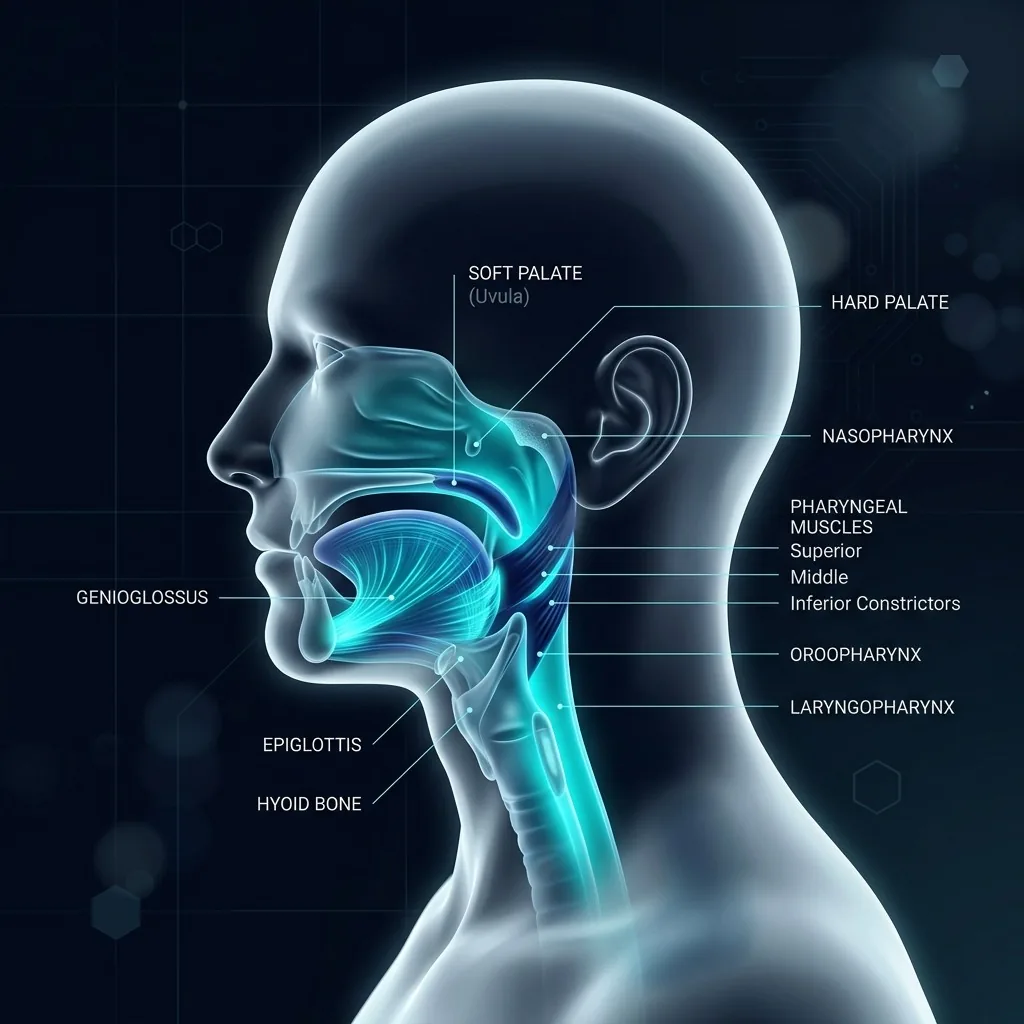
Snoring starts when the airway narrows during sleep. The tongue and soft palate relax and drift back. Air has to squeeze past them, the tissue vibrates, and you get the sound. When the gap closes far enough, breathing pauses. That is apnea.
The base of the tongue is a big part of that gap. A bulkier tongue crowds the space before you even fall asleep. So there are two ways to open the airway. Make the tongue take up less room. And make it strong enough to hold its position instead of sagging back.
The 2026 study is the first to show the exercises doing both at once. Less volume. More strength. That is the mechanism people have described for years, caught on a scan.
This is the routine, built into an app
Airway Trainer runs the same kind of tongue and throat drills the study used. Short guided sessions you do at home, a few minutes a day. No clinic visit needed.


The trials that back it up
A single small study is not proof. What makes the 2026 result worth attention is that it lines up with older work.
The same research group ran an app-based trial earlier. People did the exercises through a phone app instead of in person. Their apnea-hypopnea index, the standard count of breathing events per hour, fell by 53%. It went from about 45 events an hour to 21. That is a large drop for a treatment with no device and no drug.
Go back further and the pattern holds. A 2015 randomised trial in the journal Chest put adults through three months of daily oropharyngeal exercises. Snoring frequency fell 36%. Snoring loudness fell 59%. Different labs, different years, same direction.
For the wider picture on how exercises compare with devices and the new drugs, see our guide to new sleep apnea and snoring treatments in 2026. For the exercises themselves, see how mouth exercises reduce snoring. If you want to run the routine, we cover myofunctional therapy at home and mouth exercises for sleep apnea.
What holds up, and what to watch
- The tongue was measured with ultrasound, not guessed at. The numbers are hard to argue with.
- An earlier trial by the same group cut the apnea-hypopnea index by 53% with an app-guided version of the same routines.
- A 2015 randomised trial in Chest found daily exercises cut snoring frequency 36% and loudness 59%.
- The routines were done at home over video. You do not need a clinic to run them.
- The 2026 study was small. Sixty people, and the groups were not fully randomised.
- It was tested on moderate apnea. It is not a fix for severe apnea on its own.
- The changes took three months of daily work. Skip days and you lose the effect.
- Exercises do not replace CPAP where a doctor has prescribed it. They sit alongside it.
The honest read: the exercises work best for snoring and mild to moderate apnea. They are a real treatment with a measurable effect, not a miracle. And they only work if you actually do them.
Who this is for
If you snore, if your snoring is mild, and if you have no signs of apnea, the exercises are a low-risk place to start. There is no device to wear and nothing to take. You give it three months of daily practice and see what changes.
If you are on CPAP, the exercises are an add-on, not a replacement. In the app-based trial they were tested that way, alongside the machine rather than instead of it. Keep the CPAP. Talk to your doctor before changing anything.
See a doctor first if your snoring is loud, if someone has seen you gasp or stop breathing at night, or if you wake up tired no matter how long you slept. Those point to apnea, and apnea needs a proper diagnosis before you treat it yourself.
Frequently asked questions
What did the 2026 study actually find?
Researchers led by Cristina Rodriguez-Alcala tracked 60 adults with obstructive sleep apnea over three months. One group did daily oropharyngeal (mouth and throat) exercises, guided over video rather than in a clinic. They scanned the tongue with ultrasound before and after. In the moderate-apnea group, tongue volume fell by 8 cm³ and tongue thickness by about 4 mm. Tongue strength went up at the same time. The work was published in the Journal of Clinical Sleep Medicine in 2026.
Why would a smaller tongue help snoring?
Snoring and apnea often come from the tongue and soft palate falling back and blocking the airway during sleep. A tongue that is bulkier at the base narrows that space to start with. When the exercises trim the fatty, untoned part of the muscle and firm up the rest, the tongue holds its position better and blocks the airway less. The study measured both changes: less volume, more strength.
Is this the only study that shows exercises work?
No. An earlier app-based trial from the same research group cut the apnea-hypopnea index by 53%, from about 45 events an hour to 21. A separate 2015 randomised trial in the journal Chest found three months of daily exercises cut snoring frequency by 36% and loudness by 59%. The 2026 study adds something the older ones did not: a direct picture of the tongue changing shape.
How long until it makes a difference?
The trials run for three months, and that is roughly when the measured changes show up. Some people notice quieter nights sooner. The one thing every study has in common is consistent practice. The 2026 study used about twenty minutes a day, most days of the week, done steadily over three months.
Can exercises replace my CPAP?
Not if a doctor has prescribed CPAP for moderate or severe apnea. Keep using it. The exercises were tested as a treatment for milder cases and as an add-on for people already on CPAP. Talk to your clinician before you change anything. If your snoring is mild and you have no signs of apnea, exercises are a low-risk place to start.
When should I see a doctor first?
See a doctor before self-treating if your snoring is loud, if a partner has seen you gasp or stop breathing, or if you wake up tired no matter how long you sleep. Those are signs of apnea, and apnea needs a proper diagnosis. Exercises are a starting point for mild snoring, not a substitute for that check.
Start the routine tonight
The study group did about twenty minutes of tongue and throat exercises a day, most days, for three months. Airway Trainer walks you through the same kind of routine, one short session at a time.
Medical disclaimer: this article is for education and does not replace medical advice. The 2026 study described here (Journal of Clinical Sleep Medicine) was a small, non-randomised controlled trial in adults with obstructive sleep apnea; larger randomised trials are still needed. Loud snoring with gasping, witnessed pauses in breathing, or heavy daytime sleepiness should be checked by a clinician before any self-treatment.