Myofunctional therapy at home
daily routine, online option, demystified
Myofunctional therapy at home is mostly five minutes of tongue, lip, and palate drills, done consistently. Here is what the routine actually looks like, when to do it, how online or virtual practice fits, and when a guided app is worth using.




.webp)
What myofunctional therapy at home actually looks like
Myofunctional therapy is rarely something that "happens" in an office. The clinic visit teaches you what to do; the actual therapy is the few minutes of practice you put in at home, every day, for weeks. That at-home portion is where outcomes are made or lost - and it's also the part most people quietly drop within the first ten days.
A realistic at-home myofunctional therapy routine has three ingredients: a short set of drills (tongue posture, swallow retraining, lip-seal work, palate lifts), a consistent cue to do them (after brushing your teeth is the classic), and some way to remember which drill you're on this week. None of that requires special equipment. It does require repetition.
That repetition is what changes the underlying muscle tone in the upper airway, the same family of changes covered in published oropharyngeal and myofunctional research (Ieto et al., Chest 2015; Camacho et al., Sleep 2015). A six-week home program is a reasonable trial period for most goals - long enough to feel a difference, short enough to actually finish.
*Airway Trainer is a wellness app. It does not diagnose or treat disease. Consult a healthcare provider for diagnosed sleep apnea or persistent symptoms.
The drills you actually do at home
The at-home portion is built from a small number of repeatable movements: tongue posture against the roof of the mouth, slow controlled swallows with the tongue tip up, lip seal endurance, cheek and lip resistance, and short palate-lift holds. Each one takes seconds. Done together, they make a five-minute set.
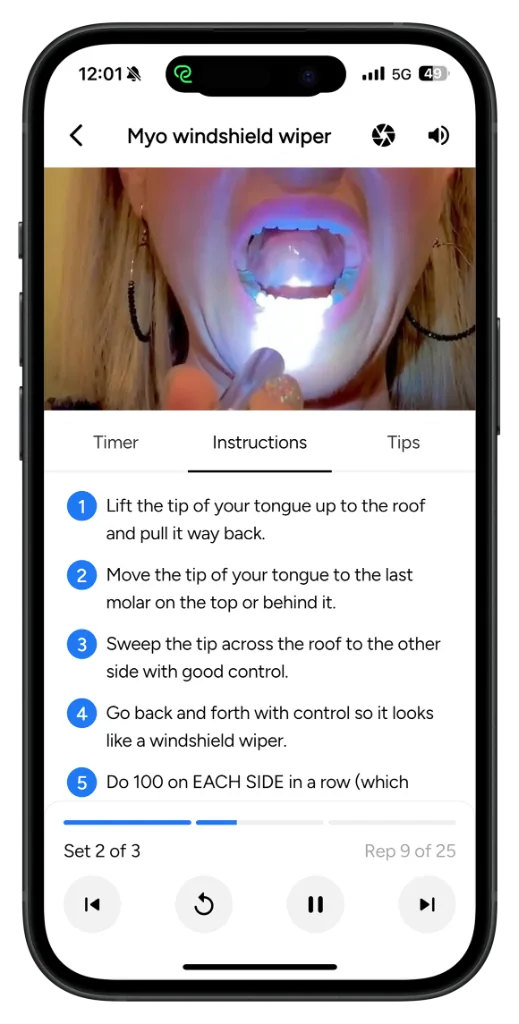
Form matters more than reps. Doing four clean lifts beats grinding twenty sloppy ones, and is the main reason most people benefit from watching a video demo for each drill instead of working from a one-page handout.
When in the day to do it
Most people who stick with it anchor the routine to something they already do every day: after brushing teeth in the morning or before bed, during the first coffee, or on a midday break. The exact time matters less than the cue. Without a cue, the routine quietly disappears in week two.
Five minutes once a day is enough for a first six-week trial. Splitting into two shorter sessions is fine. Doing nothing for three days, then trying to "make it up" with one long session, is not.
A six-week home plan, not a random exercise list
Therapy progresses for a reason. Early weeks build awareness and endurance: where the tongue actually rests, what a clean swallow feels like, whether your lips stay sealed without effort. Later weeks layer harder combinations - longer holds, paired movements, integrating drills into normal breathing.
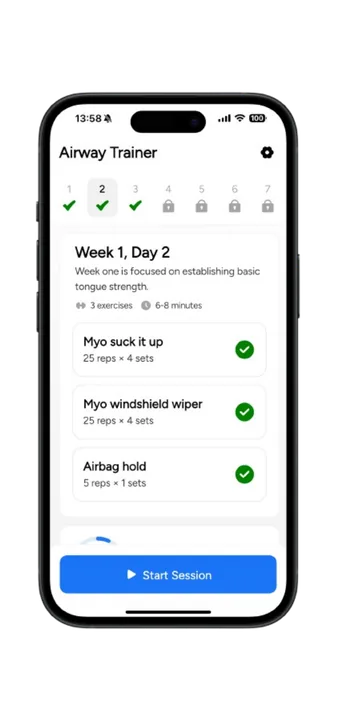
That progression is the difference between "I tried some tongue exercises" and "I completed a structured home program." A plan with weekly sequencing is what makes the at-home portion finishable instead of open-ended.
When an app helps (and when a therapist is better)
An app is genuinely useful for the home half of myofunctional therapy: it removes the "what am I supposed to do today" friction, shows clean video form for each drill, times your reps, and keeps the weekly progression on rails. If adherence is your main challenge, that's the gap an app actually closes.
A clinician is better when you need an assessment, individualized correction on form, or you're working through complex issues like tongue tie evaluation, jaw concerns, or diagnosed sleep apnea. Many people use both - clinic for assessment and review, app for daily home practice. See our myofunctional therapy app breakdown for how the app side of that pairing works.
Everything you need in one app
Related articles
Myofunctional therapy at home FAQs
Can you do myofunctional therapy online or virtually at home?
Can you do myofunctional therapy at home?
How long does at-home myofunctional therapy take each day?
Do I need any equipment for myofunctional therapy at home?
How long before I notice changes from at-home myofunctional therapy?
Is myofunctional therapy at home enough on its own?
What does a typical at-home myofunctional session include?
Can at-home myofunctional therapy help with snoring?
Should I work with a therapist or just start at home?
Is there a minimum-friction routine I can start with if 5 minutes feels like too much?
Want the at-home routine handed to you, five minutes at a time, with video form cues and a six-week plan that picks up where you left off? Start the guided program free.