Breathing exercises
for snoring
Breathing exercises for snoring use breath-resistance drills to tone the tongue, palate, and throat muscles that vibrate at night. Airway Trainer turns them into short, video-guided daily sessions, about 5 minutes a day. Free to start.




.webp)
Why breathing exercises help with snoring
Snoring is the sound of a floppy, narrowed airway vibrating as you breathe. Two things are commonly involved: weak upper-airway muscles that collapse inward during sleep, and breathing through the mouth instead of the nose. Mouth breathing lets the jaw and tongue shift backward, which measurably narrows the airway and makes it more prone to collapse (Ayuse et al., Cranio 2004). Breath-resistance and wind-instrument style drills work the throat muscles directly.
The strongest evidence here sits on the muscle-training side. A randomized trial of 39 people found that oropharyngeal exercises reduced snoring frequency and intensity over three months (Ieto et al., Chest 2015). A small randomized controlled trial of 25 people found that regular didgeridoo playing, a sustained breathing and airway-resistance exercise, clearly reduced daytime sleepiness, with a smaller and statistically borderline improvement in sleep apnea severity (Puhan et al., BMJ 2006). A small uncontrolled pilot study of daily singing exercises reported reduced snoring (Ojay and Ernst, Complementary Therapies in Medicine 2000).
Worth being straight about the limits. Those trials tested specific, resistance-based airway exercises, not nasal breathing habits, and the studies are small. If chronic nasal congestion or an obstructed nose is what pushes you into mouth breathing in the first place, that is a separate problem with its own retraining approach, not something breath-resistance drills fix.
The common thread is consistency. None of these work as a one-off. They work when the breathing and muscle drills are repeated most days for weeks. That is the part Airway Trainer is built for: it sequences the exercises into a structured plan, guides the breath timing on screen, and keeps the streak visible so the habit actually holds.
Breathing exercises for snoring are a wellness approach, not a treatment for diagnosed sleep apnea. If your snoring comes with gasping, choking, or daytime exhaustion, screen your risk with the free STOP-BANG tool and talk to a clinician. If mouth breathing and a blocked nose are the real issue, see our nasal breathing exercises page instead. For the full muscle-training routine, see our snoring exercises program.
*Airway Trainer is a wellness app. It does not diagnose or treat disease. Consult a healthcare provider for diagnosed sleep apnea or persistent symptoms.
Breath-resistance drills that train the airway directly
The exercise styles with trial evidence, oropharyngeal drills, didgeridoo-style playing, controlled-exhale work, all load the same throat and soft-palate muscles against resistance. That is a different mechanism from simply breathing through the nose more often.
Airway Trainer guides the breath cadence and resistance timing on screen so you are not guessing at counts, and pairs it with tongue and palate drills so the muscle work is structured rather than random.
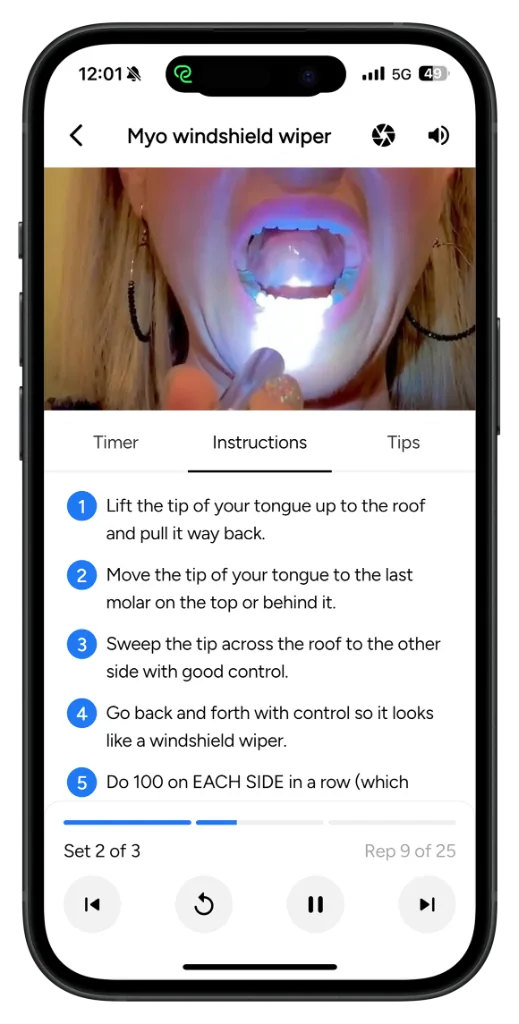
Breath and muscle drills in one structured plan
The research that shows results, from oropharyngeal exercises to didgeridoo playing to singing, all comes back to training the same airway with breath. The app combines exhale control and throat and palate resistance work into a single sequence so you cover the airway instead of doing one random drill.
The plan ramps over weeks the way a therapist would structure homework, so difficulty builds as your control improves.
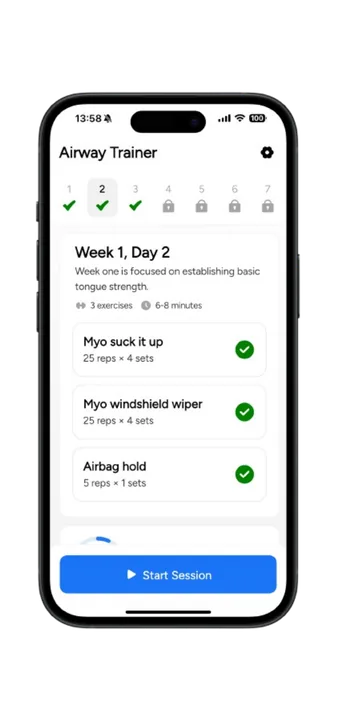
Five minutes a day, before bed or any time
The best breathing routine is the one you finish. Keeping it on your phone removes friction: five minutes before bed, after brushing your teeth, or on a break, same app, same flow, every day.
Track streaks and completed sessions so the daily practice stays visible and easy to keep going.
Everything you need in one app
Related articles
Breathing exercises for snoring FAQs
Can breathing exercises really stop snoring?
What breathing exercises are best for snoring?
How is this different from your nasal breathing exercises page?
How long before breathing exercises reduce snoring?
Are breathing exercises a substitute for treating sleep apnea?
How much time do the breathing exercises take?
Start your guided breathing and airway routine for snoring today, about 5 minutes a day, free to begin.