Sleep apnea exercises,
guided every day
Sleep apnea exercises train the tongue, soft palate, and upper-airway muscles that collapse and vibrate during sleep. Airway Trainer turns those drills into short, video-guided daily sessions, about 5 minutes a day. Free to start.




.webp)
What sleep apnea exercises actually do
Obstructive sleep apnea and heavy snoring share a mechanical cause: during sleep, the muscles of the tongue and throat relax, the airway narrows, and airflow gets turbulent or blocked. Sleep apnea exercises, also called myofunctional or oropharyngeal exercises, target exactly those muscles. The goal is to build tone and coordination in the tongue, soft palate, and pharyngeal walls so the airway stays more open during sleep.
This is not a fringe idea. A systematic review and meta-analysis of myofunctional therapy for obstructive sleep apnea reported that consistent practice reduced the apnea-hypopnea index by roughly half in adults (Camacho et al., Sleep 2015). Halved is not gone, though: the average AHI in those studies fell from about 24.5 to 12.3 events per hour, which is still in the mild to moderate range. The authors frame the exercises as an adjunct to other sleep apnea treatments, not a replacement. A separate randomized trial found that oropharyngeal exercises cut snoring frequency and intensity over three months (Ieto et al., Chest 2015). The muscles respond to training the same way any other muscle does: repetition over weeks.
The catch is adherence. These exercises only work if you actually do them, most days, for weeks. A printed handout or a one-time demo rarely survives real life. Airway Trainer exists to solve that half of the problem: it sequences the drills into a structured plan, shows you the form on video, times your reps, and keeps the streak visible so the daily habit sticks.
Sleep apnea exercises are a wellness and airway-conditioning approach, not a replacement for diagnosis or prescribed treatment. If you have diagnosed sleep apnea, keep working with your clinician and use the app as the daily practice layer. For the clinical framing, see our myofunctional exercises for sleep apnea page, and check your risk with the free STOP-BANG screening tool.
*Airway Trainer is a wellness app. It does not diagnose or treat disease. Consult a healthcare provider for diagnosed sleep apnea or persistent symptoms.
The four muscle groups the exercises target
A complete program does not just work the tongue. It trains the tongue for posture and strength, the soft palate to resist collapse, the pharyngeal side walls that narrow the airway, and the swallow and lip-seal patterns that support nasal breathing.
Airway Trainer groups the drills by muscle family and sequences them so you cover the full airway over each week, instead of guessing which random exercise to do from a video.
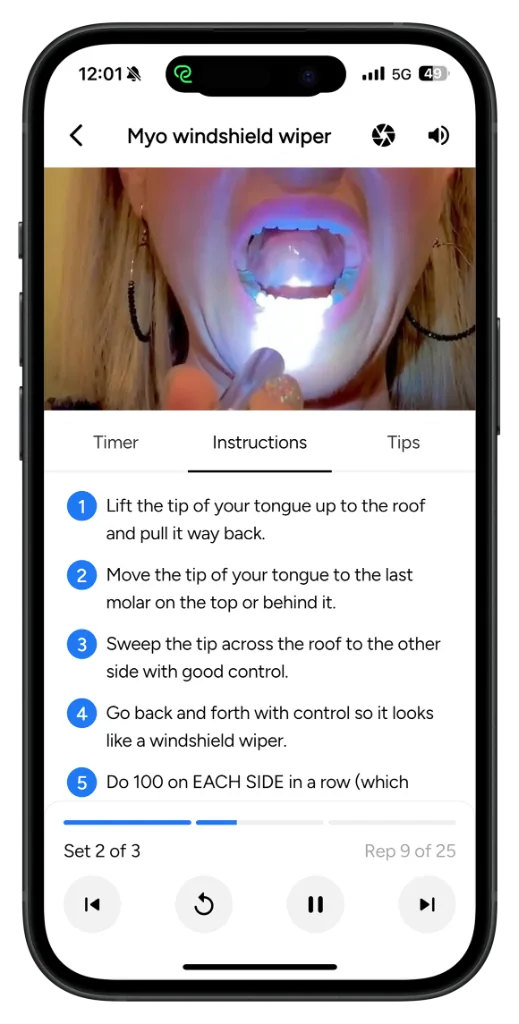
A structured plan, because consistency is the whole game
The studies that show results ran for weeks of near-daily practice. That is the hard part, and it is exactly what an app is good at. The plan ramps difficulty the way a therapist would: early weeks build awareness and endurance, later weeks layer harder combinations.
You always know what is scheduled today, what you have finished, and how the weeks connect. That is the difference between doing sleep apnea exercises for a week and doing them long enough to matter.
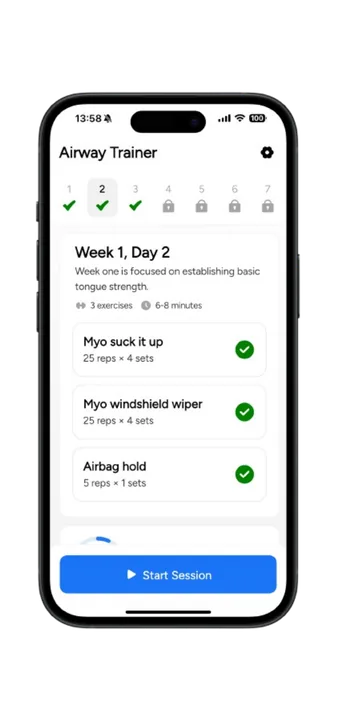
Five minutes a day, on the device you already carry
The best program is the one you actually complete. Keeping everything on your phone removes friction: five minutes before bed, after brushing your teeth, or on a break, same app, same flow, every day.
Track streaks and completed sessions so progress stays visible, and bring that record to your clinician if you are being treated for sleep apnea.
Everything you need in one app
Related articles
Sleep apnea exercises FAQs
Do sleep apnea exercises really work?
Are sleep apnea exercises a replacement for CPAP or a doctor?
How long until sleep apnea exercises show results?
How much time do the exercises take each day?
Can these exercises help snoring even if I do not have sleep apnea?
What is the difference between sleep apnea exercises and myofunctional therapy?
Start your guided sleep apnea exercise plan today, about 5 minutes a day, free to begin.