Didgeridoo for snoring
A real randomized trial tested this, not just a social-media hack. Here is how didgeridoo practice may stiffen throat and tongue muscles, what the 2006 BMJ study actually found, who is a realistic candidate, and when quieter oropharyngeal exercises cover the same idea without an instrument.


Quick answer
Yes for some people with snoring and moderate OSA - with caveats. Regular didgeridoo practice is one of the few musical interventions tested in a randomized sleep trial. In Puhan and colleagues (BMJ 2006), non-obese adults with moderate OSA who took lessons and practiced about 25 minutes most days for 4 months improved daytime sleepiness, lowered AHI by about 6 events/hour versus control, and disturbed partners less.
The mechanism is airway muscle training, not magic wood. If you will not practice, hate the sound, or have severe untreated apnea, this is the wrong first tool. The same training idea also shows up in structured oropharyngeal exercise studies that do not require an instrument.
How didgeridoo playing trains the airway
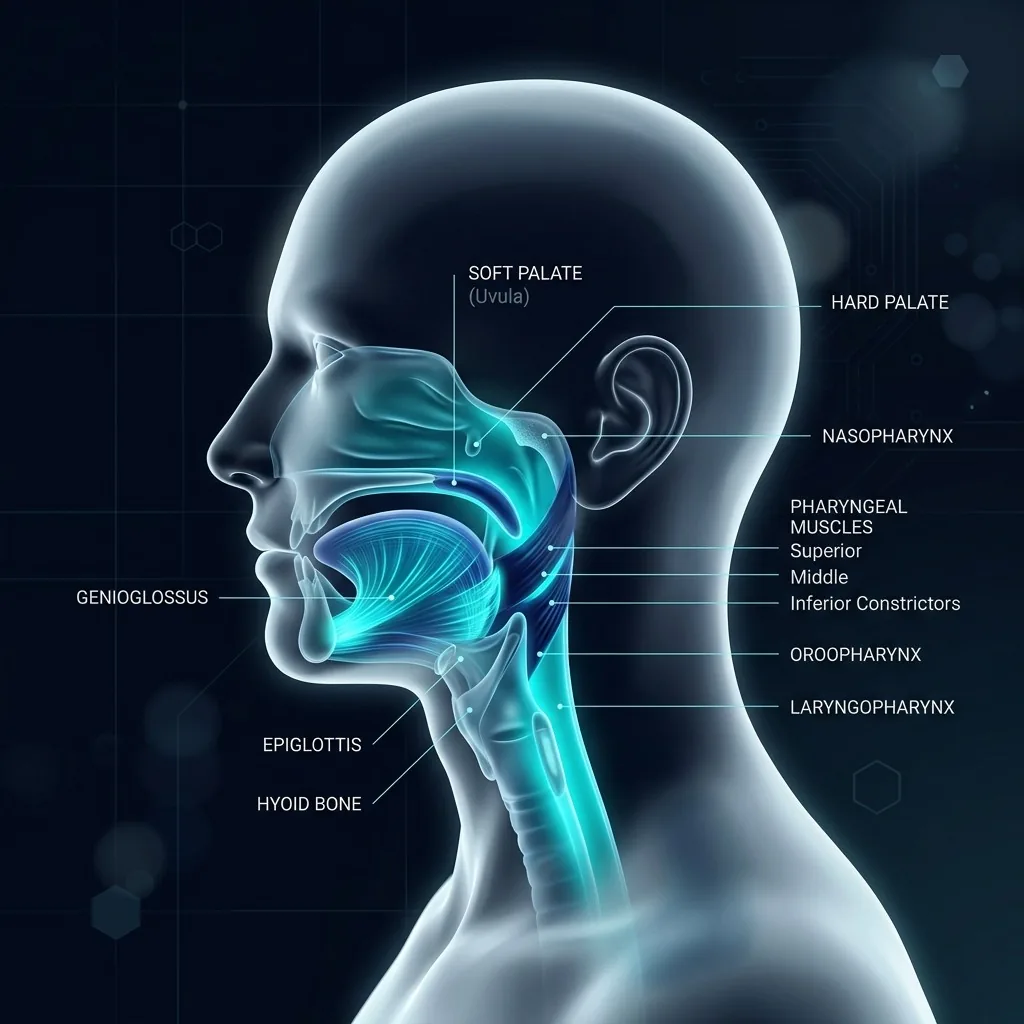
Snoring is soft tissue vibrating in a narrowed throat. Sleep already drops tone in the tongue, soft palate, and pharyngeal walls. Instruments that load those tissues for long, controlled minutes may raise baseline stiffness so collapse is less likely at night.
A didgeridoo is a long tube. The basic drone is a sustained lip buzz against acoustic back-pressure. Teachers and sleep clinicians point to three loads that matter for snoring: tongue-base effort, soft-palate and cheek seal, and the circular-breathing pattern that keeps air moving while you inhale through the nose. Endoscopy demos during play show the deep throat opening and the tongue base working - demonstration context, not a substitute for trial outcomes.
Primary training target
Tongue-base and pharyngeal wall tone
The continuous drone and back-pressure load the base of the tongue and the side walls of the throat. Sleep physicians who scope players during a drone describe the tongue base working hard and the deep throat opening - the same regions that collapse in many snorers.
Secondary benefit path
Soft-palate stiffness and seal
Holding a sealed embouchure against instrument resistance trains palate and buccal (cheek) muscles that help keep the soft palate from fluttering. Wind-instrument and singing cohorts have long been studied for lower OSA risk; the didgeridoo trial is the cleanest experimental test of that idea.
The hard skill inside the hobby
Circular breathing as a throat workout
Circular breathing means cheek-bellow air out while you inhale through the nose. Teachers emphasize that the brief throat close-and-release under pressure is where a lot of the airway work lives. It takes practice; beginners usually start with a simple lip drone before adding circular breathing.
Not a universal cure
What it does not fix
Didgeridoo practice will not unclog a severely blocked nose, shrink large tonsils, reverse major jaw anatomy issues, or replace CPAP for people who need positive pressure. Responses in trials vary person to person. Severe OSA, obesity outside the studied range, and apnea red flags need medical care first.
What the BMJ trial showed
Puhan and colleagues (BMJ 2006; PMID 16377643) ran a randomized controlled trial in Switzerland. They enrolled 25 adults with snoring and moderate OSA (AHI 15-30), excluded current CPAP, obesity (BMI 30+), heavy alcohol use, and CNS sedatives, then assigned people to didgeridoo lessons plus home practice or a waiting-list control for 4 months.
Intervention participants received a standardized acrylic didgeridoo and four lessons covering the lip drone, circular breathing, and technique to transmit upper-airway vibration. They were asked to practice at least 20 minutes on at least five days a week. Diaries showed about 25.3 minutes on 5.9 days per week on average.
Versus control, the didgeridoo group improved daytime sleepiness on the Epworth scale (difference about -3.0 points), lowered AHI (difference about -6.2 events/hour), and reduced partner-rated sleep disturbance on a 0-10 scale (difference about -2.8). Self-rated sleep quality (Pittsburgh) did not differ significantly. The authors concluded regular didgeridoo playing was an effective, well-accepted option for moderate OSA in this small sample.
Read those numbers with adult skepticism. The trial is small, single-center, not sham-instrument controlled, and limited to non-obese moderate OSA. Individual responses in airway-training research often vary widely. It is a strong proof of concept for muscle training, not a license to abandon prescribed therapy.
Later myofunctional and oropharyngeal exercise research (Guimaraes 2009, Ieto 2015, Camacho 2015 meta-analysis) expands the same idea with structured drills instead of music. Those programs report snoring and AHI improvements in selected adults, again with study-size and adherence limits.
Who didgeridoo practice is for
Best-fit profile (closest to the trial)
- Primary snoring or mild-to-moderate OSA after a real sleep evaluation
- Partner-rated snoring that bothers the household
- Willingness to practice about 20-30 minutes most days for months, not one weekend
- Curious about a skill-based option instead of (or beside) another nighttime device
Weaker or unclear fit
- Severe untreated OSA (AHI often 30+), especially with cardiovascular risk
- BMI and comorbidities outside what small trials studied
- Main problem is fixed nasal blockage, not floppy throat tissue
- You will not practice consistently or household noise is a hard stop
See a clinician first if...
- Gasping, choking, or witnessed breathing pauses
- Severe daytime sleepiness, morning headaches, or resistant high blood pressure
- You already use CPAP and adherence or mask issues are the real problem
- Chest pain, dizziness, or ear problems when you try wind instruments
How people actually practice (trial-style dose)
You do not need concert-level music. You need consistent airway load. Instructors and the trial protocol both start simple: hold a clean drone, then layer circular breathing, then extend session length.
Weeks 1-2
Lip drone first
Buzz the lips into the mouthpiece to hold a steady keynote for 20-30 seconds. Feel vibration and mild pressure in the lips and upper airway. Skip fancy rhythms until the drone is clean.
Weeks 2-4
Add circular breathing
Store air in the cheeks, keep air flowing out while you sneak a nasal inhale, then reconnect lung air. Practice with a finger under the nose or a straw drill before the full instrument if needed.
Ongoing
Build a daily dose
The BMJ trial averaged about 25 minutes on roughly 6 days a week for 4 months. Short, frequent sessions beat rare marathon blasts. Track minutes the way you would track any rehab program.
Always
Respect culture and neighbors
The didgeridoo is an Aboriginal Australian instrument with deep cultural meaning. Buy from ethical sources, learn with humility, and pick practice times that will not weaponize the hobby against your household.
This is educational, not music instruction or medical advice. If buzzing or pressure hurts your ears, jaw, or chest, stop and check with a clinician before continuing.
Expert videos on didgeridoo, snoring, and airway training
Demonstration and clinician framing only. Clinical claims on this page are grounded in the Sources list, not in video captions.
Dr. Jordan Stern, BlueSleep Snoring and Sleep Apnea Center - in-nose scope view while a player drones: tongue-base work, deep throat opening, and a plain-language summary of the 2006 BMJ practice dose.
Dr. Jeff Dugue (Buffalo TMJ) - clinician walkthrough of didgeridoo as a functional option beside CPAP, oral appliances, and surgery, plus a beginner circular-breathing cheek drill.
Didge Project - clear mechanism video: partial vs full obstruction, tongue-base and throat-wall toning, plus a short patient anecdote after nasal surgery and practice.
Dylan Petkus, MD, MPH, MS - RCT AHI context, individual response variability, palate/class framing, and why some people prefer instrument-free tongue and palate training with the same goal.
Daran Wallman (instructor) - back-pressure explanation, feeling vibration in the throat, and why circular breathing is the progressive load many teachers emphasize for airway work.
Quieter alternative: the same idea without the instrument
If the music is the fun part for you, lean into lessons and keep the dose close to the trial. If the music is the barrier - apartment walls, travel, partners who already hate noise - remember what the trial is really testing: repeated training of collapsible airway muscles.
Structured oropharyngeal and myofunctional programs train tongue posture, soft palate lift, and throat walls with short daily drills. Randomized work includes reduced snoring power (Ieto 2015) and improved OSA metrics versus sham (Guimaraes 2009). Camacho's 2015 meta-analysis pooled adult myofunctional studies and found roughly half the starting AHI on average, with snoring and sleepiness gains too. Those are not didgeridoo clones, and study quality still varies - but they are the practical twin of the musical approach.
A sensible stack for many snorers: rule out red-flag apnea, fix obvious nasal blockage when present, try side sleep if back sleep is loud, then pick one training path you will finish - didgeridoo or guided tongue/palate/throat work. Deep-dive guides: tongue exercises, soft-palate drills, throat exercises, and the clinical studies roundup.
Airway Trainer packages those drills into a guided daily session when a didgeridoo is not practical - same muscle-training goal, no late-night drone.
When to see a doctor first
Buying an instrument is not a sleep evaluation. Get medical care - do not only start a hobby - if you have:
- Gasping, choking, or witnessed pauses in breathing
- Loud snoring with severe daytime sleepiness or nodding off
- Morning headaches or resistant high blood pressure
- Known moderate-severe OSA and you are thinking of quitting CPAP
Didgeridoo practice, guided airway exercises, positional therapy, oral appliances, weight management, nasal care, and CPAP each solve different pieces. Match the tool to the cause after a real assessment when red flags are present.
Sources
- Puhan MA, et al. BMJ. 2006 Feb 4;332(7536):266-270. PMID: 16377643.
Randomized controlled trial (n=25, moderate OSA AHI 15-30, non-obese): 4 months of didgeridoo lessons plus home practice (~26 min on ~6 days/week) improved daytime sleepiness (Epworth difference -3.0), lowered AHI (difference -6.2 events/hour), and reduced partner-rated sleep disturbance versus a waiting-list control. - Puhan MA, et al. BMJ 2006 - full text (open access).
Full trial methods: acrylic didgeridoo, four lessons (lip drone, circular breathing, upper-airway vibration technique), home practice diary, and exclusion of current CPAP, CNS sedatives, heavy alcohol use, and BMI >= 30. - Camacho M, et al. Sleep. 2015 May 1;38(5):669-675. PMID: 25348130.
Meta-analysis of myofunctional (oropharyngeal) therapy for OSA: pooled adult studies showed roughly 50% AHI reduction plus improvements in snoring and sleepiness - the same muscle-training idea as didgeridoo, without requiring an instrument. - Ieto V, et al. Chest. 2015 Sep;148(3):683-691. PMID: 25950418.
Randomized trial: oropharyngeal exercises reduced snoring frequency and snoring power in habitual snorers. - Guimaraes KC, et al. Am J Respir Crit Care Med. 2009 May 15;179(10):962-968. PMID: 19234106.
Randomized trial: daily upper-airway exercises improved OSA outcomes versus sham therapy. - Mayo Clinic. Snoring: Symptoms and causes / Obstructive sleep apnea treatment.
Clinical context: snoring and OSA come from collapsible upper-airway tissue; lifestyle, devices, CPAP, and surgery are standard paths - muscle-training approaches sit alongside, not instead of, evaluation when apnea red flags appear.
Didgeridoo for snoring: FAQs
Does didgeridoo playing help snoring?
It can for some people. A 2006 randomized BMJ trial in moderate obstructive sleep apnea (AHI 15-30) found that about 4 months of lessons plus daily home practice improved daytime sleepiness, lowered AHI by roughly 6 events per hour versus control, and reduced partner-rated sleep disturbance. Snoring and OSA still have many causes, so results are not guaranteed, and the study was small (25 people).
How does a didgeridoo reduce snoring or sleep apnea?
The leading explanation is upper-airway muscle training. Holding a lip drone against the instrument back-pressure works the tongue base, soft palate region, and pharyngeal walls. Circular breathing adds a cheek-and-throat load. Stronger, stiffer tissues are less likely to collapse and vibrate during sleep. This is the same broad idea behind oropharyngeal and myofunctional exercise programs studied in other trials.
How long do you need to practice the didgeridoo for snoring?
In the Puhan trial, people practiced about 25 minutes a day on nearly 6 days a week for 4 months, with four structured lessons covering the drone and circular breathing. There is no proven shortcut dose. Expect weeks to months, not one session after a viral video.
Is didgeridoo better than throat exercises for snoring?
They target overlapping muscles with different packaging. Didgeridoo is one randomized signal for a musical training load. Oropharyngeal exercise trials (for example Ieto 2015 and Guimaraes 2009) and a myofunctional therapy meta-analysis (Camacho 2015) support structured tongue, palate, and throat drills without an instrument. Choose the format you will actually stick with. Neither replaces evaluation when apnea red flags are present.
Can I get didgeridoo benefits without learning the instrument?
Partly. The shared mechanism is training collapsible airway muscles. Guided tongue, soft-palate, and throat exercises try to deliver that load in a quiet, short daily session. You lose the hobby and the specific acoustic back-pressure of a didgeridoo, but you keep the muscle-training idea that several clinical programs study. For many people living in apartments or with light sleepers, the exercise path is more practical.
Is didgeridoo safe if I have sleep apnea?
The BMJ trial enrolled non-obese adults with moderate OSA who were not on CPAP and screened out heavy alcohol use and CNS sedatives. It is not clearance to drop prescribed CPAP or to self-treat severe apnea. Get a diagnosis, talk with your clinician before changing therapy, and stop if you feel lightheaded, dizzy, or have ear or jaw pain.
When should I see a doctor instead of buying a didgeridoo?
See a clinician for gasping, choking, witnessed pauses, severe sleepiness, morning headaches, resistant high blood pressure, or loud snoring that continues despite lifestyle changes. A quieter hobby is not a sleep study. Use STOP-BANG or similar screens only as a nudge toward care, not as a diagnosis.
Train the airway - with music or without
The didgeridoo trial is a memorable proof that upper-airway muscles respond to practice. Airway Trainer keeps that training idea in a quiet, guided routine when a long wooden tube is not the right tool for your home.
Related reading: Oropharyngeal exercise studies · Throat exercises for snoring · Alcohol and snoring